기본을 소중히 한다
가금현 기자입력 : 2026. 05. 24(일) 15:54


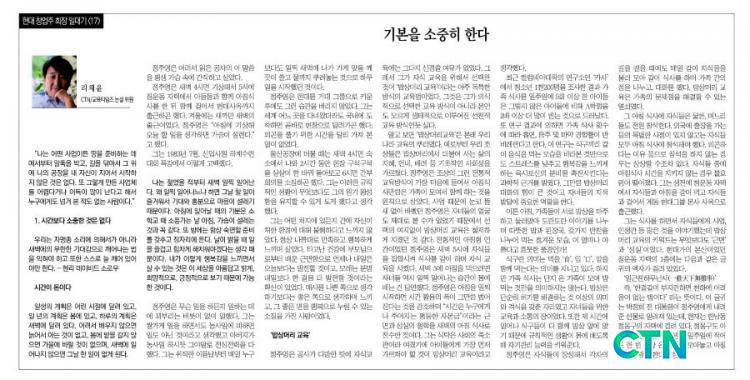
교육타임즈 98호 보도
[리채윤의 실천하라, 정주영처럼/CTN]"나는 어떤 사업이든 땅을 준비하는 데에서부터 말뚝을 박고, 길을 닦아서 그 위에 나의 공장을 내 자신이 지어서 시작하지 않은 것은 없다. 또 그렇게 만든 사업체를 어렵다거나 이득이 많이 난다고 해서 누구에게도 넘겨 본 적도 없는 사람이다"
1. 시간보다 소중한 것은 없다.
우리는 자명종 소리에 의해서가 아니라 새벽에의 무한한 기대감으로 깨어나는 법을 익혀야 하고 또한 스스로 늘 깨어 있어야만 한다. - 헨리 데이비드 소로우
시간이 돈이다
일생의 계획은 어린 시절에 달려 있고, 일 년의 계획은 봄에 있고, 하루의 계획은 새벽에 달려 있다. 어려서 배우지 않으면 늙어서 아는 것이 없고, 봄에 밭을 갈지 않으면 가을에 바랄 것이 없으며, 새벽에 일어나지 않으면 그날 한 일이 없게 된다.
정주영은 어려서 읽은 공자의 이 말씀을 평생 가슴 속에 간직하고 살았다.
정주영은 새벽 4시면 기상해서 5시에 청운동 자택에서 아들들과 함께 아침식사를 한 뒤 함께 걸어서 현대사옥까지 출근하곤 했다. 겨울에는 새까만 새벽의 출근이었다. 정주영은 "아침에 기상해 오늘 할 일을 생각하면 가슴이 설렌다."고 했다.
그는 1983년 7월, 신입사원 하계수련대회 특강에서 이렇게 고백했다.
나는 젊었을 적부터 새벽 일찍 일어난다. 왜 일찍 일어나느냐 하면 그날 할 일이 즐거워서 기대와 흥분으로 마음이 설레기 때문이다. 아침에 일어날 때의 기분은 소학교 때 소풍가는 날 아침, 가슴이 설레는 것과 꼭 같다. 또 밤에는 항상 숙면할 준비를 갖추고 잠자리에 든다. 날이 밝을 때 일을 즐겁고 힘차게 해치워야겠다는 생각 때문이다. 내가 이렇게 행복감을 느끼면서 살 수 있는 것은 이 세상을 아름답고 밝게, 희망적으로, 긍정적으로 보기 때문에 가능한 것이다.
정주영은 무슨 일을 하든지 일하는 데에 꾀부리는 버릇이 없이 일했다. 그는 쌀가게 일을 하면서도 농사일에 비하면 일도 아닌 것이라고 생각했고 아버지가 농사일 하시듯 그야말로 전심전력을 다했다. 그는 취직한 이튿날부터 매일 누구보다도 일찍 새벽에 나가 가게 앞을 깨끗이 쓸고 물까지 뿌려놓는 것으로 하루 일을 시작했던 것이다.
정주영은 현대를 거대 그룹으로 키운 후에도 그런 습관을 버리지 않았다. 그는 세계 어느 곳을 다녀왔더라도 국내에 도착하면 곧바로 현장으로 달려가곤 했다. 피곤을 풀기 위한 시간을 달리 가져 본 일이 없었다.
울산공장에 머물 때는 새벽 4시면 숙소에서 나와 2시간 동안 현장 구석구석을 샅샅이 한 바퀴 돌아보고 6시면 간부회의를 소집하곤 했다. 그는 이러한 규칙적인 생활이 무엇보다도 그의 원기 왕성함을 유지할 수 있게 도게 했다고 생각했다.
그는 어떤 처지에 있든지 간에 자신이 처한 환경에 대해 불행하다고 느끼지 않았다. 항상 나름대로 만족하고 행복하게 느끼며 살았다. 타고난 건강에 부모님으로부터 배운 근면함으로 언제나 내일은 오늘보다는 발전할 것이고, 모레는 분명 내일보다 한 걸음 더 발전할 것이라는 확신이 있었다. 매사를 나쁜 쪽으로 생각하기보다는 좋은 쪽으로 생각하며 느끼고, 그 좋은 면을 행복으로 누릴 수 있는 소질을 가진 사람이었다.
‘밥상머리 교육’
정주영은 공사가 다망한 탓에 자식교육에는 그다지 신경쓸 여유가 없었다. 그래서 그가 자식 교육을 위해서 선택한 것이 ‘밥상머리 교육’이라는 아주 독특한 방식의 교육법이었다. 그것은 그가 의식적으로 선택한 교육 방식이 아니라 본인도 모르게 생태적으로 이루어진 선천적 교육 방식인듯 싶다.
알고 보면 ‘밥상머리교육’은 본래 우리나라 교육의 뿌리였다. 예로부터 우리 조상들은 밥상머리에서 더불어 사는 삶의 지혜, 인내, 배려 등 기초적인 사회성을 가르쳤다. 정주영은 조상의 그런 전통적 교육방식이 가장 마음에 들어서 아침식사만큼은 가족이 모여서 함께 하는 것을 원칙으로 삼았다. 사업 때문에 눈코 뜰 새 없이 바빴던 정주영은 자녀들의 얼굴도 제대로 볼 수가 없었기 때문에서 선택의 여지없이 밥상머리 교육은 철저하게 지켰던 것 같다. 전형적인 아침형 인간이었던 정주영은 새벽 5시에 자식들을 집합시켜 식사를 같이 하며 자식 교육을 시켰다. 새벽 5에 아침을 먹으려면 자녀들 역시 일찍 일어나는 습관이 몸에 배는 건 당연했다. 정주영은 아침을 일찍 시작하면 시간 활용의 폭이 그만큼 법어진다는 것을 강조하며 “시간은 누구에게나 주어지는 평등한 자본금”이라는 근면과 성실의 철학을 새벽의 아침 식사로 전수한 것이다. 그는 식탁은 사회의 축소판이라 여겼기에 아이들에게 가장 먼저 가르쳐야 할 것이 밥상머리 교육이라고 생각했다.
최근 컬럼비아대학의 연구소인 ‘카사’에서 청소년 1천200명을 조사한 결과 가족 식사를 일주일에 5회 이상 한 아이들은 그렇지 않은 아이들에 비해 A학점을 2배 이상 더 많이 받는 것으로 드러났다. 또 연구 결과에 의하면 가족 식사 횟수에 따라 흡연, 음주 및 마약 경험률이 반비례한다고 한다. 이 연구는 식구끼리 같이 음식을 먹는 모습을 바라본 것만으로도 스트레스를 낮추고 행복감을 느끼게 하는 옥시토신의 분비를 촉진시킨다는 과학적 근거를 밝혔다. 그만큼 밥상머리 대화의 힘이 큰 것이고 자녀들의 지적 발달에 중요한 역할을 한다.
이른 아침, 가족들이 서로 밥상을 마주하고 둘러앉아 도란도란 이야기를 나누며 따뜻한 밥과 된장국, 갖가지 반찬을 나누어 먹는 정겨운 모습, 이 얼마나 아름다고 흐뭇한 풍경인가!
식구란 의미는 먹을 ‘食’, 입 ‘口’, 밥을 함께 먹는다는 의미를 지니고 있다. 하지만 가족 식사는 단지 온 가족이 모여 밥 먹는 것만을 의미하지는 않는다. 밥상은 단순히 허기를 해결하는 것 이상의 의미와 격식을 갖춘 자리였고 자녀들을 위한 교육과 소통의 장이었다. 또한 제 시간에 일어나 식구들이 다 함께 밥상 앞에 앉기 때문에 규칙적인 생활이 몸에 배도록 해 자기관리 능력을 키워준다.
정주영은 자식들이 장성해서 각자의 길을 걸을 때에도 매일 같이 자식들을 불러 모아 같이 식사를 하며 가족 간의 정을 나누고, 대화를 했다. 밥상머리 교육은 가족의 문제점을 해결할 수 있는 열쇠였다.
그 아침 식사에 자식들은 물론, 며느리들도 전원 참석한다. 외국에 출장을 가는 등의 특별한 사정이 있지 않고는 자식들 모두 아침 식사에 참석해야 했다. 피곤하다는 이유 등으로 참석을 하지 않는 경우는 상상할 수조차 없다. 자식들 중에 아침식사 시간을 지키지 않는 경우 불호령이 떨어졌다. 그는 생전에 청운동 자택에서 자식들과 아침을 같이 먹고 자식들과 걸어서 계동 현대그룹 본사 사옥으로 출근했다.
그는 식사를 하면서 자식들에게 사업, 인생관 등 많은 것을 이야기했는데 밥상머리 교육의 키워드는 무엇보다도 '근면'과 '성실'이었다. 현대가의 본산이었던 청운동 자택의 1층에는 다음과 같은 글귀의 액자가 걸려 있었다.
'일근천하무난사(一動天下無難事)'
즉, ‘한결같이 부지런하면 천하에 어려움이 없는 법이다' 라는 뜻이다. 이 글귀는 박정희 전 대통령이 정주영에게 내려준 선물로 알려져 있는데, 현재는 한남동 정몽구의 자택에 걸려 있다. 정몽구도 아버지의 정신을 이어 받아 일주일에 적어도 한 번 이상 온 가족을 모아놓고 아침식사를 함께 한다고 한다.
[영문번역-AI]
[Lee Chae-yoon’s "Practice Like Chung Ju-yung"] Cherishing the Basics
By Lee Chae-yoon, Editorial Writer for CTN/Education Times
“In any business I pursued, I never started without preparing the land myself, driving the stakes, clearing the roads, and building my own factory on top of it. Furthermore, I am a person who has never handed over a business I built to someone else just because it became difficult or highly profitable.”
1. Nothing Is More Precious Than Time
We must learn to reawaken each day not by the sound of an alarm clock, but by an infinite expectation of the dawn, and we must always maintain that self-awareness. — Henry David Thoreau
Time is Money
The plan for a lifetime depends on childhood; the plan for a year depends on spring; and the plan for a day depends on the dawn. If you do not learn when you are young, you will know nothing when you are old. If you do not plow the fields in spring, you will have nothing to hope for in autumn. If you do not rise at dawn, you will achieve nothing that day.
Chung Ju-yung cherished these words of Confucius, which he read in his youth, in his heart throughout his entire life.
Chung would wake up at 4:00 AM every morning, have breakfast with his sons at his Cheongun-dong residence at 5:00 AM, and then walk to the Hyundai headquarters with them to start the workday. In the winter, this commute took place in the pitch-black dawn. Chung once said, "When I wake up in the morning and think about the work I have to do today, my heart flutters with excitement."
In July 1983, during a special lecture at the summer training camp for new employees, he made the following confession:
"Since my youth, I have always risen early in the morning. The reason I wake up early is that I am thrilled and excited about the work I get to do that day. The way I feel when I get up in the morning is exactly like the fluttering heart of an elementary school student on the morning of a school picnic. At night, I always go to bed fully prepared for a deep sleep. This is because I want to handle my work enjoyably and vigorously when daylight breaks. The reason I can live feeling this sense of happiness is that I view this world beautifully, brightly, hopefully, and positively."
No matter what task he undertook, Chung Ju-yung worked without ever slacking off. Even when working at a rice store, he considered it effortless compared to farming, dedicating his entire heart and soul to it just as his father had done with agriculture. From the very day after he was hired, he began his day earlier than anyone else by sweeping the front of the store clean and sprinkling water on the ground.
Chung did not abandon this habit even after growing Hyundai into a massive conglomerate. No matter where he traveled in the world, he would rush straight to the worksite as soon as he arrived back in Korea. He never set aside separate time to relieve his fatigue.
When staying at the Ulsan plant, he would leave his quarters at 4:00 AM, thoroughly inspect every nook and cranny of the site for two hours, and then convene a meeting with executives at 6:00 AM. He believed that this disciplined, regular lifestyle was what allowed him to maintain his robust vitality above all else.
No matter his circumstances, he never felt unhappy about his environment. He always lived feeling satisfied and happy in his own way. Blessed with innate health and the diligence he learned from his parents, he possessed an unwavering conviction that tomorrow would be better than today, and the day after tomorrow would surely be one step further advanced than tomorrow. He was a person naturally gifted at looking on the bright side of things rather than the negative, turning those positive aspects into happiness.
'Tabletop Education' (Dining Table Education)
Because he was immensely busy with public and private affairs, Chung Ju-yung did not have much time to spare for his children's education. Therefore, the method he chose was an incredibly unique approach known as "Tabletop Education" (Babsangmeori Education). Rather than a consciously chosen strategy, it seemed to be an innate, organic form of parenting that came naturally to him.
In truth, Tabletop Education was originally the root of Korean traditional upbringing. From ancient times, Korean ancestors taught basic social skills—such as the wisdom of living together, patience, and consideration for others—around the dining table. Chung favored this traditional ancestral method the most, making it a strict rule for the family to gather for breakfast. Because he was so busy running his businesses that he barely had time to see his children's faces, he strictly maintained this dining table routine out of necessity.
As a quintessential morning person, Chung summoned his children at 5:00 AM to eat breakfast together and instill valuable life lessons. To eat breakfast at 5:00 AM, the children naturally had to develop the habit of waking up early. Emphasizing that starting the morning early expands the scope of how one utilizes time, Chung imparted his philosophy of diligence and sincerity through these dawn meals, often saying, "Time is an equal capital given to everyone." Because he viewed the dining table as a microcosm of society, he believed that Tabletop Education was the very first thing children needed to be taught.
A recent study by 'CASA', a research institute at Columbia University, surveyed 1,200 adolescents and revealed that children who had family dinners five or more times a week were more than twice as likely to receive A grades compared to those who did not. The study also showed that rates of smoking, drinking, and drug use among youth were inversely proportional to the frequency of family meals. Furthermore, scientific evidence proved that simply looking at family members eating together triggers the secretion of oxytocin, which lowers stress and fosters happiness. This demonstrates the immense power of dining table conversations and its crucial role in children's intellectual development.
How beautiful and heartwarming is the sight of a family sitting together early in the morning, sharing warm rice, soybean paste soup, and various side dishes while chatting amiably!
In Korean, the word for family member is Sik-gu (食口), which literally means "eating mouth"—implying those who share meals together. However, a family meal signifies more than just gathering to eat. The dining table was a place of etiquette that went beyond merely satisfying hunger; it was a forum for education and communication for the children. Moreover, because everyone had to wake up on time to sit together, it helped cultivate self-management skills by embedding a disciplined routine into their lives.
Even when his children grew up and went their separate ways, Chung continued to gather them daily to share meals, bond, and converse. Tabletop Education was his key to resolving family issues.
Not only his sons but also all of his daughters-in-law had to attend those breakfasts. Unless there were exceptional circumstances, such as an overseas business trip, everyone was required to be present. Missing the meal simply due to fatigue was utterly unimaginable. If any child failed to keep the breakfast time, a thunderous scolding would follow. During his lifetime, he would eat breakfast with his children at his Cheongun-dong home and then walk with them to the Hyundai Group headquarters in Gye-dong.
During these meals, he spoke extensively about business and his philosophy on life. The ultimate keywords of his Tabletop Education were, above all, "Diligence" and "Sincerity." On the first floor of the Cheongun-dong residence—the birthplace of the Hyundai family—hung a framed calligraphy piece with the following phrase:
'일근천하무난사 (一勤天下無難事)'
"If one is consistently diligent, nothing under heaven is difficult."
This phrase is known to be a gift bestowed upon Chung Ju-yung by former President Park Chung-hee, and it currently hangs in the Hannam-dong residence of Chung Mong-koo. Inheriting his father’s spirit, Chung Mong-koo is also said to gather his entire family for breakfast at least once a week.
#정주영 #현대그룹 #정주영철학 #기본을소중히 #시간관리 #새벽기상 #아침형인간 #근면성실 #밥상머리교육 #가족식사 #일근천하무난사 #이채윤칼럼 #리채윤 #경영철학 #자기관리
1. 시간보다 소중한 것은 없다.
우리는 자명종 소리에 의해서가 아니라 새벽에의 무한한 기대감으로 깨어나는 법을 익혀야 하고 또한 스스로 늘 깨어 있어야만 한다. - 헨리 데이비드 소로우
시간이 돈이다
일생의 계획은 어린 시절에 달려 있고, 일 년의 계획은 봄에 있고, 하루의 계획은 새벽에 달려 있다. 어려서 배우지 않으면 늙어서 아는 것이 없고, 봄에 밭을 갈지 않으면 가을에 바랄 것이 없으며, 새벽에 일어나지 않으면 그날 한 일이 없게 된다.
정주영은 어려서 읽은 공자의 이 말씀을 평생 가슴 속에 간직하고 살았다.
정주영은 새벽 4시면 기상해서 5시에 청운동 자택에서 아들들과 함께 아침식사를 한 뒤 함께 걸어서 현대사옥까지 출근하곤 했다. 겨울에는 새까만 새벽의 출근이었다. 정주영은 "아침에 기상해 오늘 할 일을 생각하면 가슴이 설렌다."고 했다.
그는 1983년 7월, 신입사원 하계수련대회 특강에서 이렇게 고백했다.
나는 젊었을 적부터 새벽 일찍 일어난다. 왜 일찍 일어나느냐 하면 그날 할 일이 즐거워서 기대와 흥분으로 마음이 설레기 때문이다. 아침에 일어날 때의 기분은 소학교 때 소풍가는 날 아침, 가슴이 설레는 것과 꼭 같다. 또 밤에는 항상 숙면할 준비를 갖추고 잠자리에 든다. 날이 밝을 때 일을 즐겁고 힘차게 해치워야겠다는 생각 때문이다. 내가 이렇게 행복감을 느끼면서 살 수 있는 것은 이 세상을 아름답고 밝게, 희망적으로, 긍정적으로 보기 때문에 가능한 것이다.
정주영은 무슨 일을 하든지 일하는 데에 꾀부리는 버릇이 없이 일했다. 그는 쌀가게 일을 하면서도 농사일에 비하면 일도 아닌 것이라고 생각했고 아버지가 농사일 하시듯 그야말로 전심전력을 다했다. 그는 취직한 이튿날부터 매일 누구보다도 일찍 새벽에 나가 가게 앞을 깨끗이 쓸고 물까지 뿌려놓는 것으로 하루 일을 시작했던 것이다.
정주영은 현대를 거대 그룹으로 키운 후에도 그런 습관을 버리지 않았다. 그는 세계 어느 곳을 다녀왔더라도 국내에 도착하면 곧바로 현장으로 달려가곤 했다. 피곤을 풀기 위한 시간을 달리 가져 본 일이 없었다.
울산공장에 머물 때는 새벽 4시면 숙소에서 나와 2시간 동안 현장 구석구석을 샅샅이 한 바퀴 돌아보고 6시면 간부회의를 소집하곤 했다. 그는 이러한 규칙적인 생활이 무엇보다도 그의 원기 왕성함을 유지할 수 있게 도게 했다고 생각했다.
그는 어떤 처지에 있든지 간에 자신이 처한 환경에 대해 불행하다고 느끼지 않았다. 항상 나름대로 만족하고 행복하게 느끼며 살았다. 타고난 건강에 부모님으로부터 배운 근면함으로 언제나 내일은 오늘보다는 발전할 것이고, 모레는 분명 내일보다 한 걸음 더 발전할 것이라는 확신이 있었다. 매사를 나쁜 쪽으로 생각하기보다는 좋은 쪽으로 생각하며 느끼고, 그 좋은 면을 행복으로 누릴 수 있는 소질을 가진 사람이었다.
‘밥상머리 교육’
정주영은 공사가 다망한 탓에 자식교육에는 그다지 신경쓸 여유가 없었다. 그래서 그가 자식 교육을 위해서 선택한 것이 ‘밥상머리 교육’이라는 아주 독특한 방식의 교육법이었다. 그것은 그가 의식적으로 선택한 교육 방식이 아니라 본인도 모르게 생태적으로 이루어진 선천적 교육 방식인듯 싶다.
알고 보면 ‘밥상머리교육’은 본래 우리나라 교육의 뿌리였다. 예로부터 우리 조상들은 밥상머리에서 더불어 사는 삶의 지혜, 인내, 배려 등 기초적인 사회성을 가르쳤다. 정주영은 조상의 그런 전통적 교육방식이 가장 마음에 들어서 아침식사만큼은 가족이 모여서 함께 하는 것을 원칙으로 삼았다. 사업 때문에 눈코 뜰 새 없이 바빴던 정주영은 자녀들의 얼굴도 제대로 볼 수가 없었기 때문에서 선택의 여지없이 밥상머리 교육은 철저하게 지켰던 것 같다. 전형적인 아침형 인간이었던 정주영은 새벽 5시에 자식들을 집합시켜 식사를 같이 하며 자식 교육을 시켰다. 새벽 5에 아침을 먹으려면 자녀들 역시 일찍 일어나는 습관이 몸에 배는 건 당연했다. 정주영은 아침을 일찍 시작하면 시간 활용의 폭이 그만큼 법어진다는 것을 강조하며 “시간은 누구에게나 주어지는 평등한 자본금”이라는 근면과 성실의 철학을 새벽의 아침 식사로 전수한 것이다. 그는 식탁은 사회의 축소판이라 여겼기에 아이들에게 가장 먼저 가르쳐야 할 것이 밥상머리 교육이라고 생각했다.
최근 컬럼비아대학의 연구소인 ‘카사’에서 청소년 1천200명을 조사한 결과 가족 식사를 일주일에 5회 이상 한 아이들은 그렇지 않은 아이들에 비해 A학점을 2배 이상 더 많이 받는 것으로 드러났다. 또 연구 결과에 의하면 가족 식사 횟수에 따라 흡연, 음주 및 마약 경험률이 반비례한다고 한다. 이 연구는 식구끼리 같이 음식을 먹는 모습을 바라본 것만으로도 스트레스를 낮추고 행복감을 느끼게 하는 옥시토신의 분비를 촉진시킨다는 과학적 근거를 밝혔다. 그만큼 밥상머리 대화의 힘이 큰 것이고 자녀들의 지적 발달에 중요한 역할을 한다.
이른 아침, 가족들이 서로 밥상을 마주하고 둘러앉아 도란도란 이야기를 나누며 따뜻한 밥과 된장국, 갖가지 반찬을 나누어 먹는 정겨운 모습, 이 얼마나 아름다고 흐뭇한 풍경인가!
식구란 의미는 먹을 ‘食’, 입 ‘口’, 밥을 함께 먹는다는 의미를 지니고 있다. 하지만 가족 식사는 단지 온 가족이 모여 밥 먹는 것만을 의미하지는 않는다. 밥상은 단순히 허기를 해결하는 것 이상의 의미와 격식을 갖춘 자리였고 자녀들을 위한 교육과 소통의 장이었다. 또한 제 시간에 일어나 식구들이 다 함께 밥상 앞에 앉기 때문에 규칙적인 생활이 몸에 배도록 해 자기관리 능력을 키워준다.
정주영은 자식들이 장성해서 각자의 길을 걸을 때에도 매일 같이 자식들을 불러 모아 같이 식사를 하며 가족 간의 정을 나누고, 대화를 했다. 밥상머리 교육은 가족의 문제점을 해결할 수 있는 열쇠였다.
그 아침 식사에 자식들은 물론, 며느리들도 전원 참석한다. 외국에 출장을 가는 등의 특별한 사정이 있지 않고는 자식들 모두 아침 식사에 참석해야 했다. 피곤하다는 이유 등으로 참석을 하지 않는 경우는 상상할 수조차 없다. 자식들 중에 아침식사 시간을 지키지 않는 경우 불호령이 떨어졌다. 그는 생전에 청운동 자택에서 자식들과 아침을 같이 먹고 자식들과 걸어서 계동 현대그룹 본사 사옥으로 출근했다.
그는 식사를 하면서 자식들에게 사업, 인생관 등 많은 것을 이야기했는데 밥상머리 교육의 키워드는 무엇보다도 '근면'과 '성실'이었다. 현대가의 본산이었던 청운동 자택의 1층에는 다음과 같은 글귀의 액자가 걸려 있었다.
'일근천하무난사(一動天下無難事)'
즉, ‘한결같이 부지런하면 천하에 어려움이 없는 법이다' 라는 뜻이다. 이 글귀는 박정희 전 대통령이 정주영에게 내려준 선물로 알려져 있는데, 현재는 한남동 정몽구의 자택에 걸려 있다. 정몽구도 아버지의 정신을 이어 받아 일주일에 적어도 한 번 이상 온 가족을 모아놓고 아침식사를 함께 한다고 한다.
[영문번역-AI]
[Lee Chae-yoon’s "Practice Like Chung Ju-yung"] Cherishing the Basics
By Lee Chae-yoon, Editorial Writer for CTN/Education Times
“In any business I pursued, I never started without preparing the land myself, driving the stakes, clearing the roads, and building my own factory on top of it. Furthermore, I am a person who has never handed over a business I built to someone else just because it became difficult or highly profitable.”
1. Nothing Is More Precious Than Time
We must learn to reawaken each day not by the sound of an alarm clock, but by an infinite expectation of the dawn, and we must always maintain that self-awareness. — Henry David Thoreau
Time is Money
The plan for a lifetime depends on childhood; the plan for a year depends on spring; and the plan for a day depends on the dawn. If you do not learn when you are young, you will know nothing when you are old. If you do not plow the fields in spring, you will have nothing to hope for in autumn. If you do not rise at dawn, you will achieve nothing that day.
Chung Ju-yung cherished these words of Confucius, which he read in his youth, in his heart throughout his entire life.
Chung would wake up at 4:00 AM every morning, have breakfast with his sons at his Cheongun-dong residence at 5:00 AM, and then walk to the Hyundai headquarters with them to start the workday. In the winter, this commute took place in the pitch-black dawn. Chung once said, "When I wake up in the morning and think about the work I have to do today, my heart flutters with excitement."
In July 1983, during a special lecture at the summer training camp for new employees, he made the following confession:
"Since my youth, I have always risen early in the morning. The reason I wake up early is that I am thrilled and excited about the work I get to do that day. The way I feel when I get up in the morning is exactly like the fluttering heart of an elementary school student on the morning of a school picnic. At night, I always go to bed fully prepared for a deep sleep. This is because I want to handle my work enjoyably and vigorously when daylight breaks. The reason I can live feeling this sense of happiness is that I view this world beautifully, brightly, hopefully, and positively."
No matter what task he undertook, Chung Ju-yung worked without ever slacking off. Even when working at a rice store, he considered it effortless compared to farming, dedicating his entire heart and soul to it just as his father had done with agriculture. From the very day after he was hired, he began his day earlier than anyone else by sweeping the front of the store clean and sprinkling water on the ground.
Chung did not abandon this habit even after growing Hyundai into a massive conglomerate. No matter where he traveled in the world, he would rush straight to the worksite as soon as he arrived back in Korea. He never set aside separate time to relieve his fatigue.
When staying at the Ulsan plant, he would leave his quarters at 4:00 AM, thoroughly inspect every nook and cranny of the site for two hours, and then convene a meeting with executives at 6:00 AM. He believed that this disciplined, regular lifestyle was what allowed him to maintain his robust vitality above all else.
No matter his circumstances, he never felt unhappy about his environment. He always lived feeling satisfied and happy in his own way. Blessed with innate health and the diligence he learned from his parents, he possessed an unwavering conviction that tomorrow would be better than today, and the day after tomorrow would surely be one step further advanced than tomorrow. He was a person naturally gifted at looking on the bright side of things rather than the negative, turning those positive aspects into happiness.
'Tabletop Education' (Dining Table Education)
Because he was immensely busy with public and private affairs, Chung Ju-yung did not have much time to spare for his children's education. Therefore, the method he chose was an incredibly unique approach known as "Tabletop Education" (Babsangmeori Education). Rather than a consciously chosen strategy, it seemed to be an innate, organic form of parenting that came naturally to him.
In truth, Tabletop Education was originally the root of Korean traditional upbringing. From ancient times, Korean ancestors taught basic social skills—such as the wisdom of living together, patience, and consideration for others—around the dining table. Chung favored this traditional ancestral method the most, making it a strict rule for the family to gather for breakfast. Because he was so busy running his businesses that he barely had time to see his children's faces, he strictly maintained this dining table routine out of necessity.
As a quintessential morning person, Chung summoned his children at 5:00 AM to eat breakfast together and instill valuable life lessons. To eat breakfast at 5:00 AM, the children naturally had to develop the habit of waking up early. Emphasizing that starting the morning early expands the scope of how one utilizes time, Chung imparted his philosophy of diligence and sincerity through these dawn meals, often saying, "Time is an equal capital given to everyone." Because he viewed the dining table as a microcosm of society, he believed that Tabletop Education was the very first thing children needed to be taught.
A recent study by 'CASA', a research institute at Columbia University, surveyed 1,200 adolescents and revealed that children who had family dinners five or more times a week were more than twice as likely to receive A grades compared to those who did not. The study also showed that rates of smoking, drinking, and drug use among youth were inversely proportional to the frequency of family meals. Furthermore, scientific evidence proved that simply looking at family members eating together triggers the secretion of oxytocin, which lowers stress and fosters happiness. This demonstrates the immense power of dining table conversations and its crucial role in children's intellectual development.
How beautiful and heartwarming is the sight of a family sitting together early in the morning, sharing warm rice, soybean paste soup, and various side dishes while chatting amiably!
In Korean, the word for family member is Sik-gu (食口), which literally means "eating mouth"—implying those who share meals together. However, a family meal signifies more than just gathering to eat. The dining table was a place of etiquette that went beyond merely satisfying hunger; it was a forum for education and communication for the children. Moreover, because everyone had to wake up on time to sit together, it helped cultivate self-management skills by embedding a disciplined routine into their lives.
Even when his children grew up and went their separate ways, Chung continued to gather them daily to share meals, bond, and converse. Tabletop Education was his key to resolving family issues.
Not only his sons but also all of his daughters-in-law had to attend those breakfasts. Unless there were exceptional circumstances, such as an overseas business trip, everyone was required to be present. Missing the meal simply due to fatigue was utterly unimaginable. If any child failed to keep the breakfast time, a thunderous scolding would follow. During his lifetime, he would eat breakfast with his children at his Cheongun-dong home and then walk with them to the Hyundai Group headquarters in Gye-dong.
During these meals, he spoke extensively about business and his philosophy on life. The ultimate keywords of his Tabletop Education were, above all, "Diligence" and "Sincerity." On the first floor of the Cheongun-dong residence—the birthplace of the Hyundai family—hung a framed calligraphy piece with the following phrase:
'일근천하무난사 (一勤天下無難事)'
"If one is consistently diligent, nothing under heaven is difficult."
This phrase is known to be a gift bestowed upon Chung Ju-yung by former President Park Chung-hee, and it currently hangs in the Hannam-dong residence of Chung Mong-koo. Inheriting his father’s spirit, Chung Mong-koo is also said to gather his entire family for breakfast at least once a week.
#정주영 #현대그룹 #정주영철학 #기본을소중히 #시간관리 #새벽기상 #아침형인간 #근면성실 #밥상머리교육 #가족식사 #일근천하무난사 #이채윤칼럼 #리채윤 #경영철학 #자기관리
 |
가금현 기자 ggh7000@hanmail.net
가금현 기자 입니다.
긍정적인 사고로 의리를 지키며 살고싶다.
술은 웃음소리가 밖에까지 들리도록 마셔라!
내가 그자리에 있다고
CTN·충청탑뉴스·CTN방송 발행인
|
#ChungJuYung #HyundaiGroup #ChungJuYungPhilosophy #BackToBasics #TimeManagement #WakingUpEarly #MorningPerson #DiligenceAndSincerity #TabletopEducation #FamilyMeals #FamilyTradition #BusinessPhilosophy #SelfDiscipline #LeeChaeYoon