충남수산자원연구소, 수산자원 육성·보호 전국 최고
연구소, 고수온 대응부터 수산자원 조성·질병 예방까지 현장 밀착 행정
조민성 소장 중심 연구진·관계 공무원 노력에 어업현장 기대감
폭염 피해 내수면 어민에게도 세심한 지원 필요 제기
조민성 소장 중심 연구진·관계 공무원 노력에 어업현장 기대감
폭염 피해 내수면 어민에게도 세심한 지원 필요 제기
한성진 기자입력 : 2026. 09. 23(수) 10:33


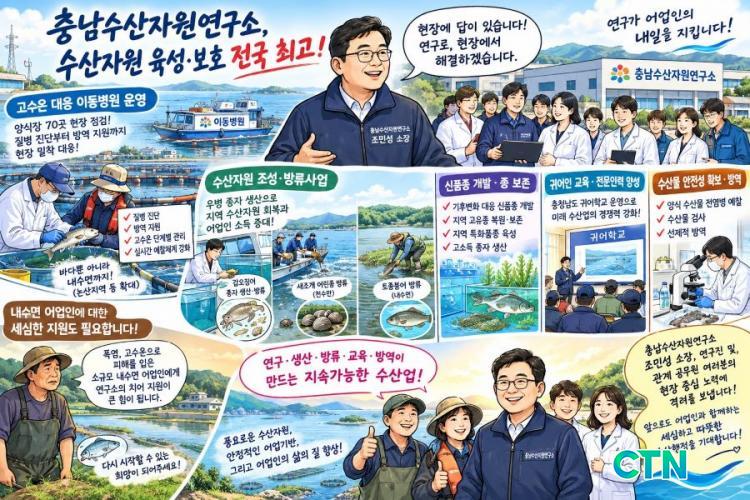
충남수산자원연구소, 수산자원 육성·보호 전국 최고/이미지편집 CTN@ai
[CTN/사회]한성진 기자=충남도 수산자원연구소(소장 조민성)가 기후변화와 고수온 등 급변하는 수산환경에 대응하면서 수산자원 육성과 보호, 어업인 소득 증대를 위한 현장 중심 행정을 펼치고 있어 주목받고 있다.
특히 조민성 충남도 수산자원연구소장을 중심으로 연구진과 관계 공무원들이 수산자원 조성에서 질병 예방, 신품종 개발, 지역 고유종 복원과 보존, 수산 전문인력 양성에 이르기까지 다양한 분야에서 현장과 함께하는 연구행정을 추진하면서 충남 수산업의 지속가능한 발전을 위한 기반을 다지고 있다는 평가가 나온다.
연구소는 최근 여름철 고수온으로 인한 수산생물 질병과 폐사를 예방하기 위해 도내 양식장을 대상으로 '고수온 대비 이동병원'을 운영했다.
국립수산과학원의 계절해양예측 결과를 반영해 선제적으로 추진한 이번 이동병원은 해상가두리와 내수면 양식장 등 약 70곳을 대상으로 현장 점검을 실시하고, 질병 진단부터 방역 지원까지 어업인들이 실제로 필요로 하는 현장 대응에 초점을 맞췄다.
특히 기존 천수만 해역 해상가두리 양식장 중심의 대응에서 벗어나 논산지역 내수면 양식장까지 점검 대상을 확대했다는 점은 기후변화로 인한 고수온 위험이 바다뿐 아니라 내수면으로까지 확대되고 있는 현실을 고려한 대응으로 볼 수 있다.
연구소 수산질병센터 전문 인력은 현장을 직접 찾아 세균성·기생충성 질병을 진단하고 감염 의심 개체를 정밀검사하는 한편, 맞춤형 치료와 예방 지도, 기생충 구제 약품과 방역 물품 지원 등 실질적인 현장 지원도 병행했다.
양식 밀도 조절, 그물망 세척 및 교체, 사료 공급 조절, 액화산소 공급, 차광막 설치 등 고수온 단계별 관리 요령을 지도하고 실시간 질병 예찰체계를 강화하는 등 피해를 최소화하기 위한 노력도 이어가고 있다.
충남수산자원연구소의 역할은 질병 예방과 양식어가 보호에만 머물지 않는다.
연구소는 자체 생산한 우량 종자를 활용해 지역 연안과 내수면의 수산자원을 회복하고 어업인의 소득 기반을 넓히기 위한 방류사업도 꾸준히 추진하고 있으며, 갑오징어의 경우 서해 연안에서 확보한 어미 개체를 활용해 직접 종자를 생산하고, 도내 연안에 종자를 방류하며 지역 수산자원 조성에 힘을 보태고 있다.
또 홍성 죽도 인근 천수만 새조개 서식지에는 어린 새조개를 방류해 지역 연안 수산자원 회복을 추진했으며, 내수면에서는 연구소가 자체 생산한 우량 토종붕어를 여러 시군의 저수지와 호수 등에 방류하며 생태계 보전과 내수면 수산자원 회복에 나서고 있다.
이 같은 연구소의 사업은 단순히 물고기나 패류를 방류하는 데 그치지 않고, 지역의 수산자원을 연구하고 종자를 직접 생산해 다시 자연과 어업현장으로 돌려보낸다는 점에서 의미가 있다.
조민성 소장은 연구소의 주요 역할로 현장 중심의 정책을 지원하는 연구를 강조하고 있다.
고수온과 김 황백화 등 기후변화에 대비한 신품종 개발과 지역 고유종의 복원·보존 연구를 추진하고 있으며, 지역 특화품종 육성과 고소득 수산 종자 생산을 통해 연구 결과를 어업현장에 이전하는 지속가능한 수산자원 관리에도 힘을 쏟고 있다.
또 충청남도 귀어학교 운영 등을 통해 귀어인의 안정적인 어촌 정착을 지원하고 수산 전문인력을 양성하는 등 미래 수산업의 경쟁력 강화를 위한 교육에도 힘쓰고 있다.
지역에서 생산되는 수산물의 안전성 확보를 위한 검사와 양식 수산물 전염병 예찰, 선제적 방역 역시 연구소가 수행하는 중요한 역할이다.
이처럼 연구·생산·방류·교육·방역을 아우르는 연구소의 활동은 수산업 현장의 어려움을 연구실 안에서만 바라보지 않고 현장에서 해결책을 찾으려는 행정의 한 사례로 평가할 수 있다.
다만 올해와 같이 폭염과 고수온으로 내수면 양식어가의 피해가 커질 경우, 상대적으로 규모가 작은 내수면 어업인들에게도 보다 세심한 행정적 관심과 지원이 필요하다는 목소리가 나온다.
특히 갑작스러운 고수온으로 물고기 집단 폐사 등 피해를 입은 소규모 어업인들에게 연구소가 직접 생산한 우량 토종붕어 등 치어를 지원할 수 있는 방안이 마련된다면, 피해 어업인들에게 단순한 물질적 지원을 넘어 다시 시작할 수 있다는 희망을 전달하는 계기가 될 수 있다는 의견이다.
물론 치어 지원은 종자 생산량과 생태계 영향, 방류 적정성, 관련 규정 및 예산 등을 종합적으로 검토해야 하는 사안이다.
그럼에도 폭염으로 생계 기반에 어려움을 겪는 소규모 내수면 어업인들의 현실을 살피고, 연구소가 축적한 종자 생산 기술과 연구 성과가 필요한 현장에 실질적으로 연결될 수 있는 방안을 검토하는 것은 의미가 크다.
충남수산자원연구소가 지금까지 추진해 온 수산자원 조성, 질병 예방, 신품종 개발, 종 보존, 귀어인 교육 등의 사업은 연구소 구성원과 관계 공무원들의 꾸준한 현장 노력 없이는 쉽지 않은 상황에서 조민성 소장을 비롯한 연구진과 관계 공무원들이 현장의 목소리에 귀 기울이고 기후변화라는 새로운 수산환경에 선제적으로 대응해 나가고 있는 만큼, 앞으로도 연구소의 전문성과 현장 행정이 더욱 긴밀하게 결합될 것으로 기대를 모으고 있다.
특히 수산자원 연구의 최종 목적이 풍요로운 수산자원과 안정적인 어업 기반, 그리고 어업인의 삶의 질 향상으로 이어진다는 점에서 연구소의 역할은 더욱 중요해지고 있다.
한편 충남도 수산자원연구소가 앞으로도 바다와 강, 호수에서 일하는 어업인들의 작은 목소리까지 세심하게 살피고, 연구 성과와 우량 종자가 실제 어업현장의 재도약으로 이어질 수 있는 정책을 지속적으로 발굴해 주길 기대하고 있다.
내수면 어업에 종사하는 한 어민은 "수산자원을 지키는 연구가 어업인의 삶을 지키는 행정으로 이어질 때, 충남의 수산업은 기후변화라는 위기 속에서도 새로운 희망을 만들어 갈 수 있을 것"며 "충남수산자원연구소의 조민성 소장, 연구진 및 관계 공무원들의 현장 중심 노력에 격려를 보내며, 앞으로도 어업인과 함께하는 세심하고 따뜻한 수산행정을 기대한다"고 밝혔다.
[영문번역 기사-ai]
Chungnam Fisheries Resources Research Institute Leads the Nation in Fisheries Resource Development and Protection
Research Institute Implements Field-Oriented Administration, from High-Temperature Response to Fisheries Resource Development and Disease Prevention
Expectations Grow Among Fishermen for Research Staff and Officials Led by Director Cho Min-seong
Greater Attention and Support Needed for Inland Water Fishermen Suffering from Extreme Heat
[CTN/Society] Reporter Ga Geum-hyeon — The Chungcheongnam-do Fisheries Resources Research Institute (Director Cho Min-seong) is drawing attention for its field-oriented efforts to respond to rapidly changing aquatic environments caused by climate change and high water temperatures, while promoting the development and protection of fisheries resources and improving fishermen's income.
In particular, under the leadership of Director Cho Min-seong, researchers and relevant public officials have been carrying out a wide range of field-based research and administrative initiatives, from fisheries resource development, disease prevention and the development of new varieties to the restoration and preservation of native species and the training of fisheries professionals. These efforts are laying the foundation for the sustainable development of Chungnam's fisheries industry.
Recently, the institute operated a "Mobile Clinic for High Water Temperature Response" at aquaculture facilities throughout the province to prevent diseases and mass mortality among aquatic organisms during the summer high-temperature period.
The mobile clinic, launched proactively based on the National Institute of Fisheries Science's seasonal ocean forecasts, conducted on-site inspections at approximately 70 facilities, including offshore cage farms and inland aquaculture facilities. The program focused on practical field support that fishermen actually need, ranging from disease diagnosis to disease-control assistance.
In particular, expanding inspections beyond offshore cage farms in the Cheonsuman Bay area to include inland aquaculture facilities in Nonsan is seen as a response that recognizes the reality that the risks associated with climate change and high water temperatures are expanding beyond marine areas into inland waters as well.
Specialists from the institute's Fisheries Disease Center visited aquaculture sites in person to diagnose bacterial and parasitic diseases and conduct detailed examinations of suspected infected specimens. They also provided customized treatment and prevention guidance, as well as antiparasitic medicines and quarantine supplies.
The institute has also continued efforts to minimize damage by providing guidance on management practices according to different stages of high water temperatures, including adjusting stocking densities, cleaning and replacing nets, regulating feed supplies, providing liquid oxygen, and installing shade screens. At the same time, it has been strengthening real-time disease surveillance systems.
The role of the Chungnam Fisheries Resources Research Institute extends beyond disease prevention and the protection of aquaculture farms.
The institute has consistently carried out stocking programs using high-quality juvenile fish and shellfish produced in-house to restore fisheries resources in coastal and inland waters and expand the income base of fishermen.
In the case of cuttlefish, the institute secures adult broodstock from the West Sea, produces juvenile cuttlefish itself, and releases them along the province's coast, contributing to the development of local fisheries resources.
The institute has also released juvenile pen shells into pen shell habitats near Jukdo Island in Hongseong, within Cheonsuman Bay, to help restore local coastal fisheries resources. In inland waters, it has released high-quality native crucian carp produced by the institute into reservoirs and lakes across several cities and counties, contributing to ecosystem conservation and the restoration of inland fisheries resources.
These initiatives are significant because they go beyond simply releasing fish or shellfish. They involve researching local fisheries resources, directly producing juvenile stock, and returning those resources to nature and fishing communities.
Director Cho Min-seong emphasizes research that supports field-oriented policies as one of the institute's key responsibilities.
The institute is conducting research into the development of new varieties in response to climate change, including high water temperatures and yellowing of laver, as well as the restoration and preservation of native species. It is also focusing on sustainable fisheries resource management by developing locally specialized species and producing high-value juvenile aquatic organisms, with the aim of transferring research outcomes directly to fishing communities.
In addition, the institute operates the Chungcheongnam-do Return-to-Fishing School to support the stable settlement of people returning to fishing and to train fisheries professionals, thereby contributing to strengthening the competitiveness of the fisheries industry of the future.
Ensuring the safety of locally produced seafood through inspections, monitoring infectious diseases in farmed aquatic products, and implementing preventive disease-control measures are also important responsibilities of the institute.
In this regard, the institute's activities—which encompass research, production, stocking, education, and disease prevention—can be viewed as an example of field-oriented administration that seeks solutions directly at fishing sites rather than addressing the challenges facing the fisheries industry solely from within research laboratories.
However, when inland aquaculture farms suffer significant damage due to extreme heat and high water temperatures, as they have this year, there are growing calls for more detailed administrative attention and support for relatively small-scale inland fishermen.
In particular, if measures could be established to provide juvenile fish, such as high-quality native crucian carp produced by the institute, to small-scale fishermen who have suffered losses such as mass fish mortality due to sudden increases in water temperatures, such support could provide more than material assistance. It could also offer affected fishermen hope and an opportunity to rebuild their livelihoods.
Of course, providing juvenile fish is an issue that requires comprehensive consideration of factors including the available quantity of juvenile stock, potential ecological impacts, the appropriateness of releases, relevant regulations, and budgetary requirements.
Nevertheless, there is considerable significance in examining ways to better understand the circumstances of small-scale inland fishermen struggling with their livelihoods due to extreme heat and to connect the institute's accumulated expertise in juvenile fish production and research achievements with the communities that need them.
The Chungnam Fisheries Resources Research Institute's programs in fisheries resource development, disease prevention, new variety development, species conservation, and education for returning fishermen would not be possible without the sustained efforts of its staff and relevant public officials.
As Director Cho Min-seong, researchers, and government officials continue to listen to the voices of fishing communities and proactively respond to the new aquatic environment created by climate change, expectations are growing that the institute's expertise and field-oriented administration will become even more closely integrated in the future.
In particular, given that the ultimate goal of fisheries resource research is to create abundant fisheries resources, a stable foundation for fishing communities, and improved quality of life for fishermen, the role of the research institute is becoming increasingly important.
Meanwhile, there are growing expectations that the Chungcheongnam-do Fisheries Resources Research Institute will continue to pay close attention to even the smallest voices of fishermen working in the sea, rivers, and lakes, while developing policies that can ensure that research achievements and high-quality juvenile stock lead to the actual recovery and revitalization of fishing communities.
An inland fisherman said:"When research aimed at protecting fisheries resources leads to administration that protects the livelihoods of fishermen, Chungnam's fisheries industry can create new hope even amid the crisis of climate change. I would like to express my encouragement to Director Cho Min-seong, the researchers, and relevant public officials at the Chungnam Fisheries Resources Research Institute for their field-oriented efforts, and I hope they will continue to pursue thoughtful and compassionate fisheries administration together with fishermen."
특히 조민성 충남도 수산자원연구소장을 중심으로 연구진과 관계 공무원들이 수산자원 조성에서 질병 예방, 신품종 개발, 지역 고유종 복원과 보존, 수산 전문인력 양성에 이르기까지 다양한 분야에서 현장과 함께하는 연구행정을 추진하면서 충남 수산업의 지속가능한 발전을 위한 기반을 다지고 있다는 평가가 나온다.
연구소는 최근 여름철 고수온으로 인한 수산생물 질병과 폐사를 예방하기 위해 도내 양식장을 대상으로 '고수온 대비 이동병원'을 운영했다.
국립수산과학원의 계절해양예측 결과를 반영해 선제적으로 추진한 이번 이동병원은 해상가두리와 내수면 양식장 등 약 70곳을 대상으로 현장 점검을 실시하고, 질병 진단부터 방역 지원까지 어업인들이 실제로 필요로 하는 현장 대응에 초점을 맞췄다.
특히 기존 천수만 해역 해상가두리 양식장 중심의 대응에서 벗어나 논산지역 내수면 양식장까지 점검 대상을 확대했다는 점은 기후변화로 인한 고수온 위험이 바다뿐 아니라 내수면으로까지 확대되고 있는 현실을 고려한 대응으로 볼 수 있다.
연구소 수산질병센터 전문 인력은 현장을 직접 찾아 세균성·기생충성 질병을 진단하고 감염 의심 개체를 정밀검사하는 한편, 맞춤형 치료와 예방 지도, 기생충 구제 약품과 방역 물품 지원 등 실질적인 현장 지원도 병행했다.
양식 밀도 조절, 그물망 세척 및 교체, 사료 공급 조절, 액화산소 공급, 차광막 설치 등 고수온 단계별 관리 요령을 지도하고 실시간 질병 예찰체계를 강화하는 등 피해를 최소화하기 위한 노력도 이어가고 있다.
충남수산자원연구소의 역할은 질병 예방과 양식어가 보호에만 머물지 않는다.
연구소는 자체 생산한 우량 종자를 활용해 지역 연안과 내수면의 수산자원을 회복하고 어업인의 소득 기반을 넓히기 위한 방류사업도 꾸준히 추진하고 있으며, 갑오징어의 경우 서해 연안에서 확보한 어미 개체를 활용해 직접 종자를 생산하고, 도내 연안에 종자를 방류하며 지역 수산자원 조성에 힘을 보태고 있다.
또 홍성 죽도 인근 천수만 새조개 서식지에는 어린 새조개를 방류해 지역 연안 수산자원 회복을 추진했으며, 내수면에서는 연구소가 자체 생산한 우량 토종붕어를 여러 시군의 저수지와 호수 등에 방류하며 생태계 보전과 내수면 수산자원 회복에 나서고 있다.
이 같은 연구소의 사업은 단순히 물고기나 패류를 방류하는 데 그치지 않고, 지역의 수산자원을 연구하고 종자를 직접 생산해 다시 자연과 어업현장으로 돌려보낸다는 점에서 의미가 있다.
조민성 소장은 연구소의 주요 역할로 현장 중심의 정책을 지원하는 연구를 강조하고 있다.
고수온과 김 황백화 등 기후변화에 대비한 신품종 개발과 지역 고유종의 복원·보존 연구를 추진하고 있으며, 지역 특화품종 육성과 고소득 수산 종자 생산을 통해 연구 결과를 어업현장에 이전하는 지속가능한 수산자원 관리에도 힘을 쏟고 있다.
또 충청남도 귀어학교 운영 등을 통해 귀어인의 안정적인 어촌 정착을 지원하고 수산 전문인력을 양성하는 등 미래 수산업의 경쟁력 강화를 위한 교육에도 힘쓰고 있다.
지역에서 생산되는 수산물의 안전성 확보를 위한 검사와 양식 수산물 전염병 예찰, 선제적 방역 역시 연구소가 수행하는 중요한 역할이다.
이처럼 연구·생산·방류·교육·방역을 아우르는 연구소의 활동은 수산업 현장의 어려움을 연구실 안에서만 바라보지 않고 현장에서 해결책을 찾으려는 행정의 한 사례로 평가할 수 있다.
다만 올해와 같이 폭염과 고수온으로 내수면 양식어가의 피해가 커질 경우, 상대적으로 규모가 작은 내수면 어업인들에게도 보다 세심한 행정적 관심과 지원이 필요하다는 목소리가 나온다.
특히 갑작스러운 고수온으로 물고기 집단 폐사 등 피해를 입은 소규모 어업인들에게 연구소가 직접 생산한 우량 토종붕어 등 치어를 지원할 수 있는 방안이 마련된다면, 피해 어업인들에게 단순한 물질적 지원을 넘어 다시 시작할 수 있다는 희망을 전달하는 계기가 될 수 있다는 의견이다.
물론 치어 지원은 종자 생산량과 생태계 영향, 방류 적정성, 관련 규정 및 예산 등을 종합적으로 검토해야 하는 사안이다.
그럼에도 폭염으로 생계 기반에 어려움을 겪는 소규모 내수면 어업인들의 현실을 살피고, 연구소가 축적한 종자 생산 기술과 연구 성과가 필요한 현장에 실질적으로 연결될 수 있는 방안을 검토하는 것은 의미가 크다.
충남수산자원연구소가 지금까지 추진해 온 수산자원 조성, 질병 예방, 신품종 개발, 종 보존, 귀어인 교육 등의 사업은 연구소 구성원과 관계 공무원들의 꾸준한 현장 노력 없이는 쉽지 않은 상황에서 조민성 소장을 비롯한 연구진과 관계 공무원들이 현장의 목소리에 귀 기울이고 기후변화라는 새로운 수산환경에 선제적으로 대응해 나가고 있는 만큼, 앞으로도 연구소의 전문성과 현장 행정이 더욱 긴밀하게 결합될 것으로 기대를 모으고 있다.
특히 수산자원 연구의 최종 목적이 풍요로운 수산자원과 안정적인 어업 기반, 그리고 어업인의 삶의 질 향상으로 이어진다는 점에서 연구소의 역할은 더욱 중요해지고 있다.
한편 충남도 수산자원연구소가 앞으로도 바다와 강, 호수에서 일하는 어업인들의 작은 목소리까지 세심하게 살피고, 연구 성과와 우량 종자가 실제 어업현장의 재도약으로 이어질 수 있는 정책을 지속적으로 발굴해 주길 기대하고 있다.
내수면 어업에 종사하는 한 어민은 "수산자원을 지키는 연구가 어업인의 삶을 지키는 행정으로 이어질 때, 충남의 수산업은 기후변화라는 위기 속에서도 새로운 희망을 만들어 갈 수 있을 것"며 "충남수산자원연구소의 조민성 소장, 연구진 및 관계 공무원들의 현장 중심 노력에 격려를 보내며, 앞으로도 어업인과 함께하는 세심하고 따뜻한 수산행정을 기대한다"고 밝혔다.
[영문번역 기사-ai]
Chungnam Fisheries Resources Research Institute Leads the Nation in Fisheries Resource Development and Protection
Research Institute Implements Field-Oriented Administration, from High-Temperature Response to Fisheries Resource Development and Disease Prevention
Expectations Grow Among Fishermen for Research Staff and Officials Led by Director Cho Min-seong
Greater Attention and Support Needed for Inland Water Fishermen Suffering from Extreme Heat
[CTN/Society] Reporter Ga Geum-hyeon — The Chungcheongnam-do Fisheries Resources Research Institute (Director Cho Min-seong) is drawing attention for its field-oriented efforts to respond to rapidly changing aquatic environments caused by climate change and high water temperatures, while promoting the development and protection of fisheries resources and improving fishermen's income.
In particular, under the leadership of Director Cho Min-seong, researchers and relevant public officials have been carrying out a wide range of field-based research and administrative initiatives, from fisheries resource development, disease prevention and the development of new varieties to the restoration and preservation of native species and the training of fisheries professionals. These efforts are laying the foundation for the sustainable development of Chungnam's fisheries industry.
Recently, the institute operated a "Mobile Clinic for High Water Temperature Response" at aquaculture facilities throughout the province to prevent diseases and mass mortality among aquatic organisms during the summer high-temperature period.
The mobile clinic, launched proactively based on the National Institute of Fisheries Science's seasonal ocean forecasts, conducted on-site inspections at approximately 70 facilities, including offshore cage farms and inland aquaculture facilities. The program focused on practical field support that fishermen actually need, ranging from disease diagnosis to disease-control assistance.
In particular, expanding inspections beyond offshore cage farms in the Cheonsuman Bay area to include inland aquaculture facilities in Nonsan is seen as a response that recognizes the reality that the risks associated with climate change and high water temperatures are expanding beyond marine areas into inland waters as well.
Specialists from the institute's Fisheries Disease Center visited aquaculture sites in person to diagnose bacterial and parasitic diseases and conduct detailed examinations of suspected infected specimens. They also provided customized treatment and prevention guidance, as well as antiparasitic medicines and quarantine supplies.
The institute has also continued efforts to minimize damage by providing guidance on management practices according to different stages of high water temperatures, including adjusting stocking densities, cleaning and replacing nets, regulating feed supplies, providing liquid oxygen, and installing shade screens. At the same time, it has been strengthening real-time disease surveillance systems.
The role of the Chungnam Fisheries Resources Research Institute extends beyond disease prevention and the protection of aquaculture farms.
The institute has consistently carried out stocking programs using high-quality juvenile fish and shellfish produced in-house to restore fisheries resources in coastal and inland waters and expand the income base of fishermen.
In the case of cuttlefish, the institute secures adult broodstock from the West Sea, produces juvenile cuttlefish itself, and releases them along the province's coast, contributing to the development of local fisheries resources.
The institute has also released juvenile pen shells into pen shell habitats near Jukdo Island in Hongseong, within Cheonsuman Bay, to help restore local coastal fisheries resources. In inland waters, it has released high-quality native crucian carp produced by the institute into reservoirs and lakes across several cities and counties, contributing to ecosystem conservation and the restoration of inland fisheries resources.
These initiatives are significant because they go beyond simply releasing fish or shellfish. They involve researching local fisheries resources, directly producing juvenile stock, and returning those resources to nature and fishing communities.
Director Cho Min-seong emphasizes research that supports field-oriented policies as one of the institute's key responsibilities.
The institute is conducting research into the development of new varieties in response to climate change, including high water temperatures and yellowing of laver, as well as the restoration and preservation of native species. It is also focusing on sustainable fisheries resource management by developing locally specialized species and producing high-value juvenile aquatic organisms, with the aim of transferring research outcomes directly to fishing communities.
In addition, the institute operates the Chungcheongnam-do Return-to-Fishing School to support the stable settlement of people returning to fishing and to train fisheries professionals, thereby contributing to strengthening the competitiveness of the fisheries industry of the future.
Ensuring the safety of locally produced seafood through inspections, monitoring infectious diseases in farmed aquatic products, and implementing preventive disease-control measures are also important responsibilities of the institute.
In this regard, the institute's activities—which encompass research, production, stocking, education, and disease prevention—can be viewed as an example of field-oriented administration that seeks solutions directly at fishing sites rather than addressing the challenges facing the fisheries industry solely from within research laboratories.
However, when inland aquaculture farms suffer significant damage due to extreme heat and high water temperatures, as they have this year, there are growing calls for more detailed administrative attention and support for relatively small-scale inland fishermen.
In particular, if measures could be established to provide juvenile fish, such as high-quality native crucian carp produced by the institute, to small-scale fishermen who have suffered losses such as mass fish mortality due to sudden increases in water temperatures, such support could provide more than material assistance. It could also offer affected fishermen hope and an opportunity to rebuild their livelihoods.
Of course, providing juvenile fish is an issue that requires comprehensive consideration of factors including the available quantity of juvenile stock, potential ecological impacts, the appropriateness of releases, relevant regulations, and budgetary requirements.
Nevertheless, there is considerable significance in examining ways to better understand the circumstances of small-scale inland fishermen struggling with their livelihoods due to extreme heat and to connect the institute's accumulated expertise in juvenile fish production and research achievements with the communities that need them.
The Chungnam Fisheries Resources Research Institute's programs in fisheries resource development, disease prevention, new variety development, species conservation, and education for returning fishermen would not be possible without the sustained efforts of its staff and relevant public officials.
As Director Cho Min-seong, researchers, and government officials continue to listen to the voices of fishing communities and proactively respond to the new aquatic environment created by climate change, expectations are growing that the institute's expertise and field-oriented administration will become even more closely integrated in the future.
In particular, given that the ultimate goal of fisheries resource research is to create abundant fisheries resources, a stable foundation for fishing communities, and improved quality of life for fishermen, the role of the research institute is becoming increasingly important.
Meanwhile, there are growing expectations that the Chungcheongnam-do Fisheries Resources Research Institute will continue to pay close attention to even the smallest voices of fishermen working in the sea, rivers, and lakes, while developing policies that can ensure that research achievements and high-quality juvenile stock lead to the actual recovery and revitalization of fishing communities.
An inland fisherman said:"When research aimed at protecting fisheries resources leads to administration that protects the livelihoods of fishermen, Chungnam's fisheries industry can create new hope even amid the crisis of climate change. I would like to express my encouragement to Director Cho Min-seong, the researchers, and relevant public officials at the Chungnam Fisheries Resources Research Institute for their field-oriented efforts, and I hope they will continue to pursue thoughtful and compassionate fisheries administration together with fishermen."
 |
한성진 기자 handumok@hanmail.net
한성진 기자 입니다. |
#충남도 #충청남도 #충남수산자원연구소 #조민성 #수산자원연구소 #수산자원 #수산자원육성 #수산자원보호 #수산업 #어업인 #내수면어업 #내수면양식 #양식어가 #고수온 #폭염 #기후변화 #수산질병 #이동병원 #수산방역 #갑오징어 #새조개 #토종붕어 #치어방류 #종자생산 #수산자원회복 #천수만 #귀어학교 #귀어귀촌 #수산전문인력 #현장중심행정 #어업인소득증대 #Chungnam #Chungcheongnamdo #FisheriesResources #FisheriesResearch #ChungnamFisheriesResourcesResearchInstitute #JoMinSung #FisheriesIndustry #Fishermen #InlandFisheries #Aquaculture #SmallScaleFisheries #HighWaterTemperature #ExtremeHeat #ClimateChange #AquaticDisease #MobileHospital #FisheriesDiseasePrevention #Cuttlefish #Cockle #NativeCrucianCarp #FishStocking #JuvenileFish #FisheriesResourceRestoration #Cheonsuman #ReturnToFishing #FisheriesProfessionals #FieldOrientedAdministration #FishermenIncome #SustainableFisheries