AI 시대, 다시 ‘기초 지식’으로 돌아가라
김영희 CTN 객원기자
김영희 객원기자입력 : 2026. 05. 22(금) 18:05


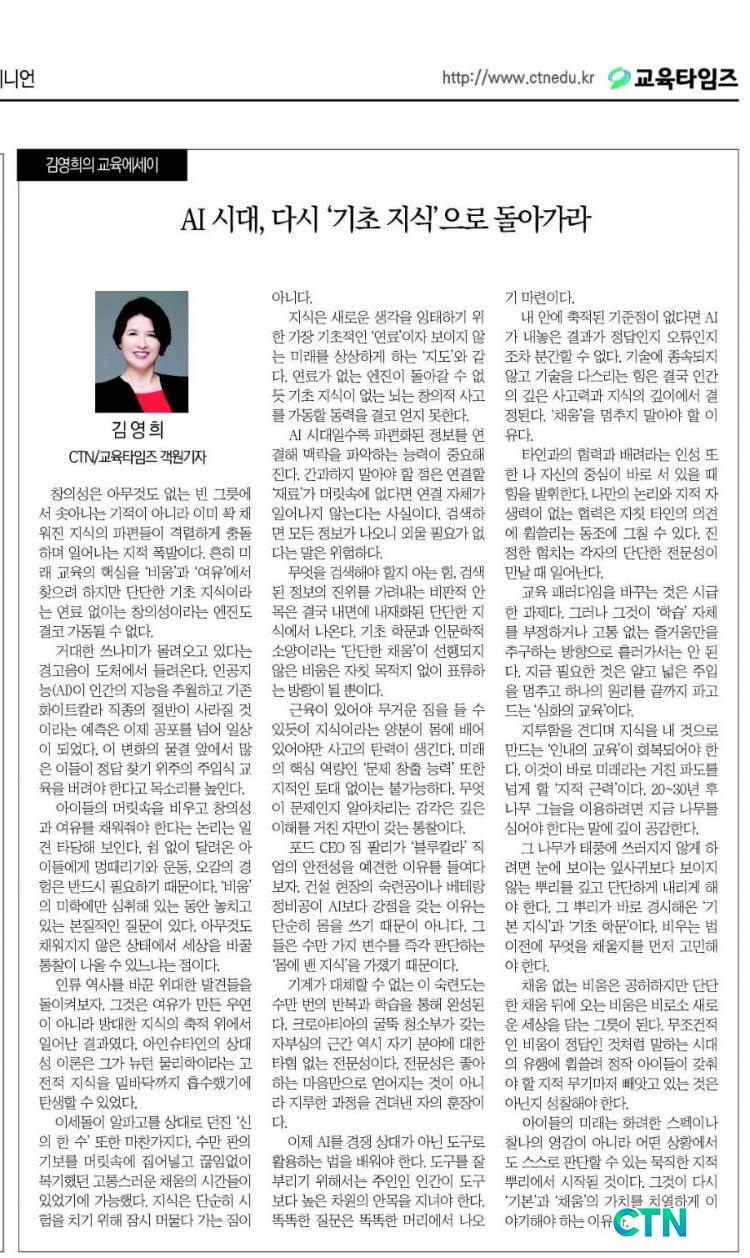
교육타임즈 98호 보도
[김영희 교육에세이/CTN]창의성은 아무것도 없는 빈 그릇에서 솟아나는 기적이 아니라 이미 꽉 채워진 지식의 파편들이 격렬하게 충돌하며 일어나는 지적 폭발이다. 흔히 미래 교육의 핵심을 ‘비움’과 ‘여유’에서 찾으려 하지만 단단한 기초 지식이라는 연료 없이는 창의성이라는 엔진도 결코 가동될 수 없다.
거대한 쓰나미가 몰려오고 있다는 경고음이 도처에서 들려온다. 인공지능(AI)이 인간의 지능을 추월하고 기존 화이트칼라 직종의 절반이 사라질 것이라는 예측은 이제 공포를 넘어 일상이 되었다. 이 변화의 물결 앞에서 많은 이들이 정답 찾기 위주의 주입식 교육을 버려야 한다고 목소리를 높인다.
아이들의 머릿속을 비우고 창의성과 여유를 채워줘야 한다는 논리는 일견 타당해 보인다. 쉼 없이 달려온 아이들에게 멍때리기와 운동, 오감의 경험은 반드시 필요하기 때문이다. ‘비움’의 미학에만 심취해 있는 동안 놓치고 있는 본질적인 질문이 있다. 아무것도 채워지지 않은 상태에서 세상을 바꿀 통찰이 나올 수 있느냐는 점이다.
인류 역사를 바꾼 위대한 발견들을 돌이켜보자. 그것은 여유가 만든 우연이 아니라 방대한 지식의 축적 위에서 일어난 결과였다. 아인슈타인의 상대성 이론은 그가 뉴턴 물리학이라는 고전적 지식을 밑바닥까지 흡수했기에 탄생할 수 있었다.
이세돌이 알파고를 상대로 던진 ‘신의 한 수’ 또한 마찬가지다. 수만 판의 기보를 머릿속에 집어넣고 끊임없이 복기했던 고통스러운 채움의 시간들이 있었기에 가능했다. 지식은 단순히 시험을 치기 위해 잠시 머물다 가는 짐이 아니다.
지식은 새로운 생각을 잉태하기 위한 가장 기초적인 ‘연료’이자 보이지 않는 미래를 상상하게 하는 ‘지도’와 같다. 연료가 없는 엔진이 돌아갈 수 없듯 기초 지식이 없는 뇌는 창의적 사고를 가동할 동력을 결코 얻지 못한다.
AI 시대일수록 파편화된 정보를 연결해 맥락을 파악하는 능력이 중요해진다. 간과하지 말아야 할 점은 연결할 ‘재료’가 머릿속에 없다면 연결 자체가 일어나지 않는다는 사실이다. 검색하면 모든 정보가 나오니 외울 필요가 없다는 말은 위험하다.
무엇을 검색해야 할지 아는 힘, 검색된 정보의 진위를 가려내는 비판적 안목은 결국 내면에 내재화된 단단한 지식에서 나온다. 기초 학문과 인문학적 소양이라는 ‘단단한 채움’이 선행되지 않은 비움은 자칫 목적지 없이 표류하는 방황이 될 뿐이다.
근육이 있어야 무거운 짐을 들 수 있듯이 지식이라는 양분이 몸에 배어 있어야만 사고의 탄력이 생긴다. 미래의 핵심 역량인 ‘문제 창출 능력’ 또한 지적인 토대 없이는 불가능하다. 무엇이 문제인지 알아차리는 감각은 깊은 이해를 거친 자만이 갖는 통찰이다.
포드 CEO 짐 팔리가 ‘블루칼라’ 직업의 안전성을 예견한 이유를 들여다보자. 건설 현장의 숙련공이나 베테랑 정비공이 AI보다 강점을 갖는 이유는 단순히 몸을 쓰기 때문이 아니다. 그들은 수만 가지 변수를 즉각 판단하는 ‘몸에 밴 지식’을 가졌기 때문이다.
기계가 대체할 수 없는 이 숙련도는 수만 번의 반복과 학습을 통해 완성된다. 크로아티아의 굴뚝 청소부가 갖는 자부심의 근간 역시 자기 분야에 대한 타협 없는 전문성이다. 전문성은 좋아하는 마음만으로 얻어지는 것이 아니라 지루한 과정을 견뎌낸 자의 훈장이다.
이제 AI를 경쟁 상대가 아닌 도구로 활용하는 법을 배워야 한다. 도구를 잘 부리기 위해서는 주인인 인간이 도구보다 높은 차원의 안목을 지녀야 한다. 똑똑한 질문은 똑똑한 머리에서 나오기 마련이다.
내 안에 축적된 기준점이 없다면 AI가 내놓은 결과가 정답인지 오류인지조차 분간할 수 없다. 기술에 종속되지 않고 기술을 다스리는 힘은 결국 인간의 깊은 사고력과 지식의 깊이에서 결정된다. ‘채움’을 멈추지 말아야 할 이유다.
타인과의 협력과 배려라는 인성 또한 나 자신의 중심이 바로 서 있을 때 힘을 발휘한다. 나만의 논리와 지적 자생력이 없는 협력은 자칫 타인의 의견에 휩쓸리는 동조에 그칠 수 있다. 진정한 협치는 각자의 단단한 전문성이 만날 때 일어난다.
교육 패러다임을 바꾸는 것은 시급한 과제다. 그러나 그것이 ‘학습’ 자체를 부정하거나 고통 없는 즐거움만을 추구하는 방향으로 흘러가서는 안 된다. 지금 필요한 것은 얕고 넓은 주입을 멈추고 하나의 원리를 끝까지 파고드는 ‘심화의 교육’이다.
지루함을 견디며 지식을 내 것으로 만드는 ‘인내의 교육’이 회복되어야 한다. 이것이 바로 미래라는 거친 파도를 넘게 할 ‘지적 근력’이다. 20~30년 후 나무 그늘을 이용하려면 지금 나무를 심어야 한다는 말에 깊이 공감한다.
그 나무가 태풍에 쓰러지지 않게 하려면 눈에 보이는 잎사귀보다 보이지 않는 뿌리를 깊고 단단하게 내리게 해야 한다. 그 뿌리가 바로 경시해온 ‘기본 지식’과 ‘기초 학문’이다. 비우는 법 이전에 무엇을 채울지를 먼저 고민해야 한다.
채움 없는 비움은 공허하지만 단단한 채움 뒤에 오는 비움은 비로소 새로운 세상을 담는 그릇이 된다. 무조건적인 비움이 정답인 것처럼 말하는 시대의 유행에 휩쓸려 정작 아이들이 갖춰야 할 지적 무기마저 빼앗고 있는 것은 아닌지 성찰해야 한다.
아이들의 미래는 화려한 스펙이나 찰나의 영감이 아니라 어떤 상황에서도 스스로 판단할 수 있는 묵직한 지적 뿌리에서 시작될 것이다. 그것이 다시 ‘기본’과 ‘채움’의 가치를 치열하게 이야기해야 하는 이유다.
[영문번역 기사-AI]
Return to “Foundational Knowledge” in the AI Era
By Kim Young-hee, CTN Guest Reporter
Creativity is not a miracle born from an empty vessel. It is an intellectual explosion that occurs when fragments of accumulated knowledge collide intensely within the mind. Many people today argue that the essence of future education lies in “emptiness” and “freedom,” but without the fuel of solid foundational knowledge, the engine of creativity can never truly run.
Warnings of a massive tsunami are echoing everywhere. Predictions that artificial intelligence (AI) will surpass human intelligence and eliminate half of existing white-collar jobs have become more than fear—they are now part of everyday reality. Faced with this wave of change, many voices insist that rote memorization and exam-centered education must disappear.
At first glance, the argument sounds persuasive: children should clear their minds and fill them instead with creativity and leisure. Certainly, young people who have spent years running nonstop need moments of idleness, exercise, and sensory experiences. Yet while society becomes fascinated with the aesthetics of “emptiness,” it risks overlooking a fundamental question: Can world-changing insight emerge from a mind that contains nothing?
Consider the great discoveries that transformed human history. They were not accidents born merely from leisure, but results built upon immense accumulations of knowledge. Albert Einstein’s theory of relativity became possible because he had thoroughly absorbed the foundations of Newtonian physics.
The same applies to Lee Sedol’s famous “divine move” against AlphaGo. That moment was only possible because he had endured years of painful discipline—memorizing countless game records and endlessly reviewing them. Knowledge is not baggage temporarily carried for an exam and then discarded.
Knowledge is the essential “fuel” for generating new ideas and the invisible “map” that allows us to imagine the future. Just as an engine cannot operate without fuel, a brain without foundational knowledge cannot power creative thinking.
In the AI era, the ability to connect fragmented information and understand context becomes increasingly important. Yet one crucial fact must not be ignored: if there are no materials stored in the mind, there can be no connection in the first place. The claim that “everything can simply be searched online” is dangerous.
The power to know what to search for, and the critical judgment needed to distinguish truth from falsehood, ultimately comes from deeply internalized knowledge. “Emptying” without first building a strong foundation in the humanities and basic disciplines can easily become aimless drifting.
Just as muscles are needed to lift heavy objects, intellectual flexibility emerges only when the nutrients of knowledge are deeply embedded within us. Even the future’s most valued skill—the ability to create problems worth solving—cannot exist without intellectual foundations. Recognizing what constitutes a meaningful problem is itself an insight born from deep understanding.
Consider why Ford CEO Jim Farley predicts greater stability for many blue-collar professions. Skilled construction workers and veteran mechanics are not irreplaceable simply because they use their hands. Their strength lies in “embodied knowledge,” the ability to instantly judge thousands of variables through experience.
This mastery cannot be replaced by machines because it is forged through countless repetitions and years of learning. Likewise, the pride of a Croatian chimney sweeper comes from uncompromising expertise in his craft. Expertise is not gained through passion alone; it is the badge earned by those who endure tedious and difficult processes.
Now we must learn to use AI not as a competitor, but as a tool. To wield a tool effectively, the human master must possess a higher level of judgment than the tool itself. Intelligent questions emerge only from intelligent minds.
Without internal standards and accumulated understanding, we cannot even determine whether AI-generated results are correct or flawed. The power to govern technology rather than become dependent on it ultimately comes from the depth of human thought and knowledge. This is why we must never stop “filling” ourselves intellectually.
Even virtues such as cooperation and empathy become meaningful only when one possesses a firmly grounded inner self. Collaboration without personal logic or intellectual independence can easily deteriorate into blind conformity. Genuine cooperation occurs when strong individual expertise meets and interacts.
Changing the educational paradigm is undoubtedly urgent. However, this change must not drift toward denying the value of learning itself or pursuing only painless enjoyment. What we need now is not shallow and broad memorization, but “education of depth” that pursues a principle to its very end.
We must restore “education of endurance,” the ability to tolerate boredom and make knowledge truly one’s own. This is the intellectual strength required to survive the rough waves of the future. The saying that we must plant trees today to enjoy their shade 20 or 30 years later resonates deeply.
But for those trees to withstand storms, their invisible roots must grow deeper and stronger than their visible leaves. Those roots are the very “basic knowledge” and “foundational disciplines” that society has long undervalued. Before discussing how to empty the mind, we must first consider what should fill it.
Emptiness without substance is hollow. Yet emptiness that follows solid intellectual accumulation becomes a vessel capable of embracing a new world. We must reflect carefully on whether society’s obsession with unconditional “emptiness” is depriving children of the intellectual weapons they truly need.
The future of our children will not begin with flashy résumés or fleeting inspiration, but with deep intellectual roots that allow them to think and judge independently under any circumstances. That is why we must once again passionately defend the value of “fundamentals” and “intellectual accumulation.”
#AI시대 #기초지식 #기본의힘 #창의성과지식 #미래교육 #교육칼럼 #인공지능시대 #지적근력 #심화학습 #인내의교육 #창의성 #비판적사고 #인문학 #기초학문 #AI교육 #평생학습 #전문성 #사고력 #교육패러다임 #지식의힘
거대한 쓰나미가 몰려오고 있다는 경고음이 도처에서 들려온다. 인공지능(AI)이 인간의 지능을 추월하고 기존 화이트칼라 직종의 절반이 사라질 것이라는 예측은 이제 공포를 넘어 일상이 되었다. 이 변화의 물결 앞에서 많은 이들이 정답 찾기 위주의 주입식 교육을 버려야 한다고 목소리를 높인다.
아이들의 머릿속을 비우고 창의성과 여유를 채워줘야 한다는 논리는 일견 타당해 보인다. 쉼 없이 달려온 아이들에게 멍때리기와 운동, 오감의 경험은 반드시 필요하기 때문이다. ‘비움’의 미학에만 심취해 있는 동안 놓치고 있는 본질적인 질문이 있다. 아무것도 채워지지 않은 상태에서 세상을 바꿀 통찰이 나올 수 있느냐는 점이다.
인류 역사를 바꾼 위대한 발견들을 돌이켜보자. 그것은 여유가 만든 우연이 아니라 방대한 지식의 축적 위에서 일어난 결과였다. 아인슈타인의 상대성 이론은 그가 뉴턴 물리학이라는 고전적 지식을 밑바닥까지 흡수했기에 탄생할 수 있었다.
이세돌이 알파고를 상대로 던진 ‘신의 한 수’ 또한 마찬가지다. 수만 판의 기보를 머릿속에 집어넣고 끊임없이 복기했던 고통스러운 채움의 시간들이 있었기에 가능했다. 지식은 단순히 시험을 치기 위해 잠시 머물다 가는 짐이 아니다.
지식은 새로운 생각을 잉태하기 위한 가장 기초적인 ‘연료’이자 보이지 않는 미래를 상상하게 하는 ‘지도’와 같다. 연료가 없는 엔진이 돌아갈 수 없듯 기초 지식이 없는 뇌는 창의적 사고를 가동할 동력을 결코 얻지 못한다.
AI 시대일수록 파편화된 정보를 연결해 맥락을 파악하는 능력이 중요해진다. 간과하지 말아야 할 점은 연결할 ‘재료’가 머릿속에 없다면 연결 자체가 일어나지 않는다는 사실이다. 검색하면 모든 정보가 나오니 외울 필요가 없다는 말은 위험하다.
무엇을 검색해야 할지 아는 힘, 검색된 정보의 진위를 가려내는 비판적 안목은 결국 내면에 내재화된 단단한 지식에서 나온다. 기초 학문과 인문학적 소양이라는 ‘단단한 채움’이 선행되지 않은 비움은 자칫 목적지 없이 표류하는 방황이 될 뿐이다.
근육이 있어야 무거운 짐을 들 수 있듯이 지식이라는 양분이 몸에 배어 있어야만 사고의 탄력이 생긴다. 미래의 핵심 역량인 ‘문제 창출 능력’ 또한 지적인 토대 없이는 불가능하다. 무엇이 문제인지 알아차리는 감각은 깊은 이해를 거친 자만이 갖는 통찰이다.
포드 CEO 짐 팔리가 ‘블루칼라’ 직업의 안전성을 예견한 이유를 들여다보자. 건설 현장의 숙련공이나 베테랑 정비공이 AI보다 강점을 갖는 이유는 단순히 몸을 쓰기 때문이 아니다. 그들은 수만 가지 변수를 즉각 판단하는 ‘몸에 밴 지식’을 가졌기 때문이다.
기계가 대체할 수 없는 이 숙련도는 수만 번의 반복과 학습을 통해 완성된다. 크로아티아의 굴뚝 청소부가 갖는 자부심의 근간 역시 자기 분야에 대한 타협 없는 전문성이다. 전문성은 좋아하는 마음만으로 얻어지는 것이 아니라 지루한 과정을 견뎌낸 자의 훈장이다.
이제 AI를 경쟁 상대가 아닌 도구로 활용하는 법을 배워야 한다. 도구를 잘 부리기 위해서는 주인인 인간이 도구보다 높은 차원의 안목을 지녀야 한다. 똑똑한 질문은 똑똑한 머리에서 나오기 마련이다.
내 안에 축적된 기준점이 없다면 AI가 내놓은 결과가 정답인지 오류인지조차 분간할 수 없다. 기술에 종속되지 않고 기술을 다스리는 힘은 결국 인간의 깊은 사고력과 지식의 깊이에서 결정된다. ‘채움’을 멈추지 말아야 할 이유다.
타인과의 협력과 배려라는 인성 또한 나 자신의 중심이 바로 서 있을 때 힘을 발휘한다. 나만의 논리와 지적 자생력이 없는 협력은 자칫 타인의 의견에 휩쓸리는 동조에 그칠 수 있다. 진정한 협치는 각자의 단단한 전문성이 만날 때 일어난다.
교육 패러다임을 바꾸는 것은 시급한 과제다. 그러나 그것이 ‘학습’ 자체를 부정하거나 고통 없는 즐거움만을 추구하는 방향으로 흘러가서는 안 된다. 지금 필요한 것은 얕고 넓은 주입을 멈추고 하나의 원리를 끝까지 파고드는 ‘심화의 교육’이다.
지루함을 견디며 지식을 내 것으로 만드는 ‘인내의 교육’이 회복되어야 한다. 이것이 바로 미래라는 거친 파도를 넘게 할 ‘지적 근력’이다. 20~30년 후 나무 그늘을 이용하려면 지금 나무를 심어야 한다는 말에 깊이 공감한다.
그 나무가 태풍에 쓰러지지 않게 하려면 눈에 보이는 잎사귀보다 보이지 않는 뿌리를 깊고 단단하게 내리게 해야 한다. 그 뿌리가 바로 경시해온 ‘기본 지식’과 ‘기초 학문’이다. 비우는 법 이전에 무엇을 채울지를 먼저 고민해야 한다.
채움 없는 비움은 공허하지만 단단한 채움 뒤에 오는 비움은 비로소 새로운 세상을 담는 그릇이 된다. 무조건적인 비움이 정답인 것처럼 말하는 시대의 유행에 휩쓸려 정작 아이들이 갖춰야 할 지적 무기마저 빼앗고 있는 것은 아닌지 성찰해야 한다.
아이들의 미래는 화려한 스펙이나 찰나의 영감이 아니라 어떤 상황에서도 스스로 판단할 수 있는 묵직한 지적 뿌리에서 시작될 것이다. 그것이 다시 ‘기본’과 ‘채움’의 가치를 치열하게 이야기해야 하는 이유다.
 |
| 김영희 CTN객원기자 |
[영문번역 기사-AI]
Return to “Foundational Knowledge” in the AI Era
By Kim Young-hee, CTN Guest Reporter
Creativity is not a miracle born from an empty vessel. It is an intellectual explosion that occurs when fragments of accumulated knowledge collide intensely within the mind. Many people today argue that the essence of future education lies in “emptiness” and “freedom,” but without the fuel of solid foundational knowledge, the engine of creativity can never truly run.
Warnings of a massive tsunami are echoing everywhere. Predictions that artificial intelligence (AI) will surpass human intelligence and eliminate half of existing white-collar jobs have become more than fear—they are now part of everyday reality. Faced with this wave of change, many voices insist that rote memorization and exam-centered education must disappear.
At first glance, the argument sounds persuasive: children should clear their minds and fill them instead with creativity and leisure. Certainly, young people who have spent years running nonstop need moments of idleness, exercise, and sensory experiences. Yet while society becomes fascinated with the aesthetics of “emptiness,” it risks overlooking a fundamental question: Can world-changing insight emerge from a mind that contains nothing?
Consider the great discoveries that transformed human history. They were not accidents born merely from leisure, but results built upon immense accumulations of knowledge. Albert Einstein’s theory of relativity became possible because he had thoroughly absorbed the foundations of Newtonian physics.
The same applies to Lee Sedol’s famous “divine move” against AlphaGo. That moment was only possible because he had endured years of painful discipline—memorizing countless game records and endlessly reviewing them. Knowledge is not baggage temporarily carried for an exam and then discarded.
Knowledge is the essential “fuel” for generating new ideas and the invisible “map” that allows us to imagine the future. Just as an engine cannot operate without fuel, a brain without foundational knowledge cannot power creative thinking.
In the AI era, the ability to connect fragmented information and understand context becomes increasingly important. Yet one crucial fact must not be ignored: if there are no materials stored in the mind, there can be no connection in the first place. The claim that “everything can simply be searched online” is dangerous.
The power to know what to search for, and the critical judgment needed to distinguish truth from falsehood, ultimately comes from deeply internalized knowledge. “Emptying” without first building a strong foundation in the humanities and basic disciplines can easily become aimless drifting.
Just as muscles are needed to lift heavy objects, intellectual flexibility emerges only when the nutrients of knowledge are deeply embedded within us. Even the future’s most valued skill—the ability to create problems worth solving—cannot exist without intellectual foundations. Recognizing what constitutes a meaningful problem is itself an insight born from deep understanding.
Consider why Ford CEO Jim Farley predicts greater stability for many blue-collar professions. Skilled construction workers and veteran mechanics are not irreplaceable simply because they use their hands. Their strength lies in “embodied knowledge,” the ability to instantly judge thousands of variables through experience.
This mastery cannot be replaced by machines because it is forged through countless repetitions and years of learning. Likewise, the pride of a Croatian chimney sweeper comes from uncompromising expertise in his craft. Expertise is not gained through passion alone; it is the badge earned by those who endure tedious and difficult processes.
Now we must learn to use AI not as a competitor, but as a tool. To wield a tool effectively, the human master must possess a higher level of judgment than the tool itself. Intelligent questions emerge only from intelligent minds.
Without internal standards and accumulated understanding, we cannot even determine whether AI-generated results are correct or flawed. The power to govern technology rather than become dependent on it ultimately comes from the depth of human thought and knowledge. This is why we must never stop “filling” ourselves intellectually.
Even virtues such as cooperation and empathy become meaningful only when one possesses a firmly grounded inner self. Collaboration without personal logic or intellectual independence can easily deteriorate into blind conformity. Genuine cooperation occurs when strong individual expertise meets and interacts.
Changing the educational paradigm is undoubtedly urgent. However, this change must not drift toward denying the value of learning itself or pursuing only painless enjoyment. What we need now is not shallow and broad memorization, but “education of depth” that pursues a principle to its very end.
We must restore “education of endurance,” the ability to tolerate boredom and make knowledge truly one’s own. This is the intellectual strength required to survive the rough waves of the future. The saying that we must plant trees today to enjoy their shade 20 or 30 years later resonates deeply.
But for those trees to withstand storms, their invisible roots must grow deeper and stronger than their visible leaves. Those roots are the very “basic knowledge” and “foundational disciplines” that society has long undervalued. Before discussing how to empty the mind, we must first consider what should fill it.
Emptiness without substance is hollow. Yet emptiness that follows solid intellectual accumulation becomes a vessel capable of embracing a new world. We must reflect carefully on whether society’s obsession with unconditional “emptiness” is depriving children of the intellectual weapons they truly need.
The future of our children will not begin with flashy résumés or fleeting inspiration, but with deep intellectual roots that allow them to think and judge independently under any circumstances. That is why we must once again passionately defend the value of “fundamentals” and “intellectual accumulation.”
#AI시대 #기초지식 #기본의힘 #창의성과지식 #미래교육 #교육칼럼 #인공지능시대 #지적근력 #심화학습 #인내의교육 #창의성 #비판적사고 #인문학 #기초학문 #AI교육 #평생학습 #전문성 #사고력 #교육패러다임 #지식의힘
 |
김영희 객원기자 kyhi6832@naver.com
|
#AIera #FoundationalKnowledge #BasicEducation #Creativity #CriticalThinking #FutureEducation #DeepLearning #Humanities #AIandEducation #IntellectualStrength #KnowledgeMatters #Learning #Expertise #EducationReform #ThinkingSkills #LifelongLearning #KnowledgeIsPower #AIfuture #EducationColumn #CognitiveSkills