경기도의 뒷북, 장마 시작되자 상황실 시찰?
-추미애 경기도지사, 6일 오전 도청 재난안전상황실 방문해 여름철 풍수해 대비태세 점검
-인명피해 3대 유형 사전 통제 및 주민대피지원단 활용 지시... 침수감지알람 등 인프라 개선 홍보
-인명피해 3대 유형 사전 통제 및 주민대피지원단 활용 지시... 침수감지알람 등 인프라 개선 홍보
김지우 기자입력 : 2026. 07. 06(월) 15:40


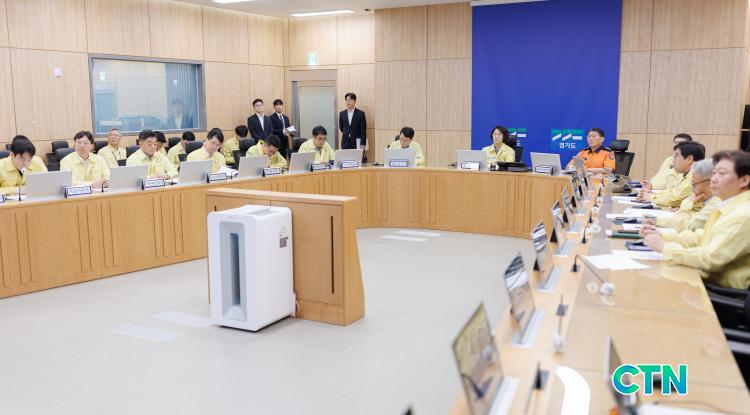
사진=경기도청 제공
[경기/CTN]김지우 기자= 추미애 경기도지사는 6일 오전 9시경 경기도청 재난안전상황실을 찾아 장마전망 등 올 여름 기상상황과 여름철 풍수해 대비 종합대책, 경기도 재난대응체계 등에 대해 보고받았다. 추 지사는 이 자리에서 "모레까지는 비가 더욱 세진다고 하니 집중해서 잘 살펴봐주시고 지금까지 준비한 대로 놓치지 말고 현장을 챙겨달라"며 "무사히 지나가길 간절히 바라지만 어디서든 사고는 돌발적으로 일어날 수 있다. 비상 연락체계를 잘 유지해달라"고 당부했다. 지난 1일 제주도를 시작으로 전국적인 장마가 시작된 가운데 도 재난대응 상황을 긴급 점검했다는 취지다.
추 지사는 이어 부단체장을 중심으로 한 대비태세 확립, 인명피해 3대 유형(산사태, 하천, 지하공간) 중심의 사전 예찰 및 통제, 주민대피지원단을 활용한 우선대피대상자 지원체계 정비, 재난 예·경보 및 민방위 시설을 활용한 긴급상황 전파 등을 지시했다. 이에 따라 도는 재난취약지역 사전점검과 현장인력 비상연락체계 점검 등 선제적인 사전 대비태세를 구축한다는 계획이다. 한편 도는 올 여름 풍수해에 대비해 도-시군-민간 합동 '재해예방대책 전담조직(T/F)'을 가동해 도내 96만여 개 취약시설에 대한 점검을 완료하고, 침수감지알람장치와 자동차단시설 등 인프라 개선을 추진해 왔다는 명분을 내세웠다.
그러나 도 당국이 도지사의 상황실 방문과 가이드라인 마련을 대단한 선제적 재난대응이자 인명피해 예방 성과로 포장하는 것과 달리, 일선 방재 전문가들과 지역 주민들 사이에서는 본격적인 집중호우가 시작된 당일 아침에서야 상황실을 찾아 지침을 하명하는 전형적인 실적주의 전시 행정이라는 비판이 쏟아지고 있다. 도시 행정 전문가들은 당장 기후위기로 매년 반복되는 반지하 주거지의 근본적인 이주 대책이나 도심 상습 침수 구역의 배수펌프 용량 증설 같은 구조적 예산 집행은 미뤄둔 채, 이미 작성된 매뉴얼을 나열하며 "철저히 챙겨달라"고 말로만 독려하는 것은 현장의 실무 공백과 인력 부족 현실을 가리는 면피성 말잔치에 불과하다고 지적한다. 특히 첨단기술 기반의 알람장치나 통제시설 설치 수치만을 앞세워 홍보하는 방식은 관청의 단기 실적 지표를 채우기 위한 얄팍한 상술일 뿐, 정작 현장에서 실시간으로 빗물받이를 청소하고 통제선에 투입될 하위직 공무원과 자율방재단의 고질적인 인력난 및 피로도 해소 등 정작 시급한 현장 실무자 지원 대책은 결여된 관료주의적 폭거라는 비판을 면하기 어렵다.
이러한 선언적인 재난 점검 표방과 일회성 순시 중심 관치 행정의 폐단을 극복하려면, 상황실 안의 수사학적 지시를 멈추고 재난 관리 시스템 자체를 현장 중심의 실무 예산 체계로 전면 개편해야 한다. 관청의 생색내기용 대규모 현장 점검 의전비와 홍보성 보도자료 발송 예산을 과감히 전면 삭감하는 대신, 침수 위험이 높은 하천변과 지하 공간에 상시 상주하며 즉각적인 통제 권한을 행사할 '시민 안전 통제관'을 거점에 상시 배치하고, 노후 배수 인프라를 직접 교체하는 정비 사업에 예산을 집중 투입해야 한다. 결과적으로 수치상의 취약시설 점검률 뒤에 숨은 행정 편의주의에서 탈피해, 실질적인 방재 시설의 가동률을 높이고 도심의 침수 복구 속도를 직접적으로 바꾸는 성과 중심의 실무 행정으로 체질을 개선해야만 도민들이 안심할 수 있는 진정한 재난 안전을 확보할 수 있을 것이다.
[영문번역 기사-AI활용]
Choo Mi-ae, Governor of Gyeonggi Province, visited the Gyeonggi Provincial Government's Disaster and Safety Situation Room around 9:00 AM on the 6th to receive briefings on this summer's meteorological outlook, comprehensive flood and storm countermeasures, and the province's disaster response framework. Choo urged at the scene, "As the rain is expected to intensify until the day after tomorrow, please monitor closely with deep concentration and inspect the fields without missing a single detail as previously prepared. While I earnestly hope we pass through safely, accidents can happen unpredictably anywhere. Please maintain the emergency contact network thoroughly." This came as part of an urgent move to review the province's disaster response readiness as the nationwide monsoon season commenced, beginning in Jeju on the 1st.
Governor Choo subsequently instructed the establishment of a readiness posture led by vice-mayors and vice-governors, preemptive inspection and control centered on the three major types of human casualties (landslides, rivers, and underground spaces), reorganization of the evacuation support network for priority evacuees, and the utilization of disaster warnings and civil defense alarms to convey critical instructions. Accordingly, the province plans to establish a proactive readiness posture by conducting preliminary checks on vulnerable sites and emergency networks. Meanwhile, the provincial authority presented a rationale that it has finalized inspections for approximately 960,000 vulnerable facilities through a joint provincial-municipal-private "Disaster Prevention Task Force" and has pushed forward infrastructure upgrades such as submersion detection alarms and automatic blocking systems.
However, in contrast to the provincial authority's extensive promotion of the governor's situation room visit and guideline drafting as a major breakthrough in preemptive disaster response and casualty prevention, local disaster mitigation experts and residents point out that it is an impractical conceptual show that issues commands at the situation room only on the morning torrential rains actually begin, serving merely as a superficial display. Municipal administration experts note that grandly advertising "thorough monitoring" while ignoring structural tasks like basic relocation policies for semi-underground residential units prone to chronic climate-driven flooding or expanding the drainage pump capacities of downtown bottlenecks is a flawed administrative distraction that leaves actual operational gaps unattended. Furthermore, relying on publicizing the installation counts of high-tech alarm devices to satisfy short-term municipal quotas is a mere bureaucratic compilation designed to meet performance metrics; thus, failing to establish immediate operational funding or practical solutions to resolve the chronic manpower shortages and physical fatigue of lower-ranking officials and voluntary disaster relief groups tasked with clearing rain gutters and securing tape lines under heavy downpours is a classic administrative malady.
To move beyond the limitations of these temporary top-down briefing events, it is imperative to halt control room-bound administrative rhetoric and immediately reorganize institutional systems to allocate public funds directly into physical, real-time drainage mitigation networks and frontline labor support. Instead of maintaining large public budgets for superficial protocol inspections or bureaucratic promotional campaigns, authorities must directly transition funding to supply urgent pump replacement subsidies and deploy permanent "Civilian Safety Control Officers" directly within high-risk subterranean hubs this year to facilitate immediate entry restrictions. Departing from volume-oriented abstract safety littered with flashy promotional modifiers, the municipality must fundamentally shift toward performance-driven practical administration that effectively minimizes actual budget leakages and directly improves the precision of regional drainage grids to restore authentic public trust.
추 지사는 이어 부단체장을 중심으로 한 대비태세 확립, 인명피해 3대 유형(산사태, 하천, 지하공간) 중심의 사전 예찰 및 통제, 주민대피지원단을 활용한 우선대피대상자 지원체계 정비, 재난 예·경보 및 민방위 시설을 활용한 긴급상황 전파 등을 지시했다. 이에 따라 도는 재난취약지역 사전점검과 현장인력 비상연락체계 점검 등 선제적인 사전 대비태세를 구축한다는 계획이다. 한편 도는 올 여름 풍수해에 대비해 도-시군-민간 합동 '재해예방대책 전담조직(T/F)'을 가동해 도내 96만여 개 취약시설에 대한 점검을 완료하고, 침수감지알람장치와 자동차단시설 등 인프라 개선을 추진해 왔다는 명분을 내세웠다.
그러나 도 당국이 도지사의 상황실 방문과 가이드라인 마련을 대단한 선제적 재난대응이자 인명피해 예방 성과로 포장하는 것과 달리, 일선 방재 전문가들과 지역 주민들 사이에서는 본격적인 집중호우가 시작된 당일 아침에서야 상황실을 찾아 지침을 하명하는 전형적인 실적주의 전시 행정이라는 비판이 쏟아지고 있다. 도시 행정 전문가들은 당장 기후위기로 매년 반복되는 반지하 주거지의 근본적인 이주 대책이나 도심 상습 침수 구역의 배수펌프 용량 증설 같은 구조적 예산 집행은 미뤄둔 채, 이미 작성된 매뉴얼을 나열하며 "철저히 챙겨달라"고 말로만 독려하는 것은 현장의 실무 공백과 인력 부족 현실을 가리는 면피성 말잔치에 불과하다고 지적한다. 특히 첨단기술 기반의 알람장치나 통제시설 설치 수치만을 앞세워 홍보하는 방식은 관청의 단기 실적 지표를 채우기 위한 얄팍한 상술일 뿐, 정작 현장에서 실시간으로 빗물받이를 청소하고 통제선에 투입될 하위직 공무원과 자율방재단의 고질적인 인력난 및 피로도 해소 등 정작 시급한 현장 실무자 지원 대책은 결여된 관료주의적 폭거라는 비판을 면하기 어렵다.
이러한 선언적인 재난 점검 표방과 일회성 순시 중심 관치 행정의 폐단을 극복하려면, 상황실 안의 수사학적 지시를 멈추고 재난 관리 시스템 자체를 현장 중심의 실무 예산 체계로 전면 개편해야 한다. 관청의 생색내기용 대규모 현장 점검 의전비와 홍보성 보도자료 발송 예산을 과감히 전면 삭감하는 대신, 침수 위험이 높은 하천변과 지하 공간에 상시 상주하며 즉각적인 통제 권한을 행사할 '시민 안전 통제관'을 거점에 상시 배치하고, 노후 배수 인프라를 직접 교체하는 정비 사업에 예산을 집중 투입해야 한다. 결과적으로 수치상의 취약시설 점검률 뒤에 숨은 행정 편의주의에서 탈피해, 실질적인 방재 시설의 가동률을 높이고 도심의 침수 복구 속도를 직접적으로 바꾸는 성과 중심의 실무 행정으로 체질을 개선해야만 도민들이 안심할 수 있는 진정한 재난 안전을 확보할 수 있을 것이다.
[영문번역 기사-AI활용]
Choo Mi-ae, Governor of Gyeonggi Province, visited the Gyeonggi Provincial Government's Disaster and Safety Situation Room around 9:00 AM on the 6th to receive briefings on this summer's meteorological outlook, comprehensive flood and storm countermeasures, and the province's disaster response framework. Choo urged at the scene, "As the rain is expected to intensify until the day after tomorrow, please monitor closely with deep concentration and inspect the fields without missing a single detail as previously prepared. While I earnestly hope we pass through safely, accidents can happen unpredictably anywhere. Please maintain the emergency contact network thoroughly." This came as part of an urgent move to review the province's disaster response readiness as the nationwide monsoon season commenced, beginning in Jeju on the 1st.
Governor Choo subsequently instructed the establishment of a readiness posture led by vice-mayors and vice-governors, preemptive inspection and control centered on the three major types of human casualties (landslides, rivers, and underground spaces), reorganization of the evacuation support network for priority evacuees, and the utilization of disaster warnings and civil defense alarms to convey critical instructions. Accordingly, the province plans to establish a proactive readiness posture by conducting preliminary checks on vulnerable sites and emergency networks. Meanwhile, the provincial authority presented a rationale that it has finalized inspections for approximately 960,000 vulnerable facilities through a joint provincial-municipal-private "Disaster Prevention Task Force" and has pushed forward infrastructure upgrades such as submersion detection alarms and automatic blocking systems.
However, in contrast to the provincial authority's extensive promotion of the governor's situation room visit and guideline drafting as a major breakthrough in preemptive disaster response and casualty prevention, local disaster mitigation experts and residents point out that it is an impractical conceptual show that issues commands at the situation room only on the morning torrential rains actually begin, serving merely as a superficial display. Municipal administration experts note that grandly advertising "thorough monitoring" while ignoring structural tasks like basic relocation policies for semi-underground residential units prone to chronic climate-driven flooding or expanding the drainage pump capacities of downtown bottlenecks is a flawed administrative distraction that leaves actual operational gaps unattended. Furthermore, relying on publicizing the installation counts of high-tech alarm devices to satisfy short-term municipal quotas is a mere bureaucratic compilation designed to meet performance metrics; thus, failing to establish immediate operational funding or practical solutions to resolve the chronic manpower shortages and physical fatigue of lower-ranking officials and voluntary disaster relief groups tasked with clearing rain gutters and securing tape lines under heavy downpours is a classic administrative malady.
To move beyond the limitations of these temporary top-down briefing events, it is imperative to halt control room-bound administrative rhetoric and immediately reorganize institutional systems to allocate public funds directly into physical, real-time drainage mitigation networks and frontline labor support. Instead of maintaining large public budgets for superficial protocol inspections or bureaucratic promotional campaigns, authorities must directly transition funding to supply urgent pump replacement subsidies and deploy permanent "Civilian Safety Control Officers" directly within high-risk subterranean hubs this year to facilitate immediate entry restrictions. Departing from volume-oriented abstract safety littered with flashy promotional modifiers, the municipality must fundamentally shift toward performance-driven practical administration that effectively minimizes actual budget leakages and directly improves the precision of regional drainage grids to restore authentic public trust.
 |
김지우 기자 ymjs790729@naver.com
김지우 기자 입니다. |