한국디지털문인협회, 'AI 시대 문학적 글쓰기' 세미나
AI는 꿈을 꾸지 않는다, 악기를 든 인간의 문학은 진화한다
김영희 객원기자입력 : 2026. 06. 12(금) 18:34


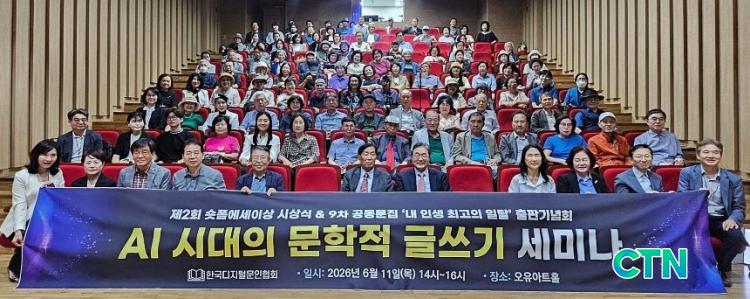
AI는 꿈을 꾸지 않는다, 악기를 든 인간의 문학은 진화한다/사진=한국디지털문인협 제공
[CTN문학관] 김영희 객원기자 = "미래는 여러 이름을 가진다. 약자에게는 불가능이고 겁 많은 자에게는 미지이며 용기 있는 자에게는 기회다" 빅토르 위고의 말처럼, 도래한 인공지능(AI) 시대는 문학계에 거대한 기회이자 질문으로 다가왔다.
지난 11일 세미나에서 한국디지털문인협회 이상우 이사장은 폴 매카트니가 꿈속에서 들은 멜로디를 옮겨 적은 명곡 'Yesterday'를 언급하며 포문을 열었다.
세계에서 가장 많이 연주된 이 노래의 출발점은 인간만의 '꿈'이었다. AI는 꿈을 꾸지 않는다. 그렇기에 인간을 완전히 따라올 수 없다.
그러나 세미나의 질문은 거기서 멈추지 않고 더 깊게 파고들었다. "그렇다면 우리는 지금 무엇을 해야 하는가?"
중앙대 이승하 교수는 AI가 인간의 일상과 감정 영역까지 깊숙이 침투한 현실의 지도를 펼쳐 보였다. AI와 감정을 교류하며 발생하는 이혼 소송, 기업들의 대규모 해고 사태는 더 이상 미래의 경고가 아닌 현재다.
이 교수는 직접 진행한 흥미로운 실험 결과를 공유했다. 파키스탄의 네 살 아이가 공장에서 일하는 사진을 두고 본인이 쓴 시와 ChatGPT, 제미나이가 쓴 시를 비교했을 때, 청중들은 세 편의 시가 "비슷비슷하다"고 평했다.
시인이 몇 시간을 고민해 쓴 시와 AI가 3초 만에 생성한 시의 격차가 생각보다 크지 않다는 '도발적 현실'이다.
이미 일본 아쿠타가와상 수상작가가 AI의 문장을 활용했다고 당당히 밝힌 시대, 이 교수는 명확한 결론을 내렸다.
"얼마나 적절히 잘 활용하느냐가 관건이다. 적의 실력을 인정하는 것, 그것이 첫 번째 용기다."
성결대 강정구 교수는 "AI가 쓴 시는 창의적인가?"라는 질문에 침묵하는 청중을 향해, 그것이 바로 플라톤 이래 서구 사상을 지배해온 '로고스 중심주의'이자 인간중심주의적 편견이라고 지적했다.
강 교수는 범용인공지능(AGI)과 포스트 휴먼이 도래할 가까운 미래에는 동물권을 넘어 '기계권'의 시대가 올 것이라 예언했다. 특히 독자가 AI의 글에서 감동을 받는다면 그것을 창의성으로 인정해야 한다는 '수용자 창의성'을 제시하며 강조했다.
"조금 지나면 인정할 수밖에 없을 것이다. AI를 이해하기 위해서는, 먼저 나 자신을 이해해야 한다."
평택대 김용희 교수는 AI를 활용한 로그라인 설정, 입체적 캐릭터 구축, 세계관 설계 등 구체적인 창작 방법론을 제시했다. 김 교수는 병자호란 시기 김상헌과 최명길의 대사를 예로 들며, 프롬프트에 인물의 무의식적 버릇이나 도덕적 결핍까지 세밀하게 담아내야 상투성을 벗어날 수 있다고 조언했다.
"조금 지나면 인정할 수밖에 없을 것이다. AI를 이해하기 위해서는, 먼저 나 자신을 이해해야 한다."
김 교수는 AI가 웹소설과 디지털 텍스트를 주로 학습하기 때문에 작가가 지향하는 문학적 방향성이 먼저 확고해야 한다고 경고하며, AI에게 절대 빼앗길 수 없는 인간만의 영역으로 '글쓰기의 즐거움과 쾌락, 행복'을 꼽았다.
이명지 수필가는 문장 생산 속도로 AI와 경쟁하는 싸움판 자체를 바꾸자고 제안했다. 그에게 수필은 단순히 완성된 글이나 자전적 고백이 아니라, 살아있는 존재가 자기 삶을 다시 읽고 성찰하는 행위다.
이 수필가는 AI를 '글을 써주는 대리인'이 아닌 '질문자'로 활용하는 역발상법을 소개했다. "아버지에 대한 글을 쓸 수 있도록 내 기억을 끌어낼 질문 20개를 해줘"라고 요청하는 방식이다.
"기술의 시대에 가장 중요한 것은 기술이 아니라 질문의 품격이다. AI는 데이터를 가지지만 경험이 없고, 이야기는 만들지만 삶은 없다. 자기 성찰이 퇴화하는 것이 AI 시대의 진짜 위기다."
황순원문학촌 총장 김종회 교수의 진행으로 이어진 토론에서는 문학계가 당면한 현실적인 난제들이 다뤄졌다.
▲AI 공동 창작물의 공모전 출품 가능 여부: 이승하 교수는 과학적 검증 시스템의 부재를 인정했고, 김용희 교수는 "AI 활용 여부로 공모전을 분리하는 것은 손바닥으로 하늘을 가리는 격"이라 지적했다. 현재 한양대 윤성호 교수 등이 다양한 실험적 분리 운영을 시도 중이다.
▲AI 글쓰기의 진정성 증명: 현재는 AI 특유의 루틴과 패턴이 존재하지만, AI의 진화에 따라 진정성의 기준도 이동할 것이다. 결국 독자가 글에서 깊은 '찔림'과 울림을 느끼는 경험 자체가 진정성의 최후 법정이 될 것이라는 의견이 모였다.
세미나를 마무리하며 네 명의 연사는 한목소리로 인간의 주체성을 역설했다.
AI는 꿈을 꾸지 않는다. 그러나 인간은 꿈을 꾼다. 꿈꾸는 존재가 AI라는 고도의 기술을 손에 쥐었을 때, 그것은 파괴적인 무기가 아니라 아름다운 '악기'가 된다.
이번 세미나는 그 악기를 어떻게 주체적으로 연주할 것인가를 묻는 자리였으며, 그 대답을 완성하는 것은 이제 기술의 파도 앞에 선 모든 창작자들의 몫으로 남았다.
[영문번역기사-AI]
AI Does Not Dream: The Evolution of Literature as Humans Take up the Instrument
[CTN Literary Hall] Guest Reporter Kim Young-hee = "The future has several names. For the weak, it is impossible; for the fainthearted, it is the unknown; for the courageous, it is opportunity." As Victor Hugo once said, the era of Artificial Intelligence (AI) has arrived in the literary world as a massive opportunity accompanied by deep questions.
At the seminar opening, Lee Sang-woo, Chairman of the Korea Digital Writers Association, opened the discussion by bringing up the story of Paul McCartney's 'Yesterday'—a masterpiece McCartney heard in a dream and transcribed upon waking. The starting point of this world-renowned song was a 'dream,' something only humans can experience. AI does not dream. For this reason, it cannot entirely replicate humanity. However, the seminar did not stop there; the inquiry went deeper: "What, then, must we do now?"
### Part 1: A World Already Begun, Confronting the 'Provocation' (Professor Lee Seung-ha)
Professor Lee Seung-ha of Chung-Ang University unfolded a map of reality where AI has deeply penetrated daily life and emotional spheres. Divorce lawsuits arising from emotional attachments to AI and mass corporate layoffs are no longer warnings of a distant future—they are the present.
Professor Lee shared the results of an intriguing experiment he conducted. When comparing a poem he wrote about a photo of the 'Smiling Jesus' statue with poems generated by ChatGPT and Gemini, the audience evaluated the three poems as "remarkably similar." This represents a 'provocation' of reality—the gap between a poem pondered over for hours by a poet and one generated in three seconds by AI is surprisingly narrow.
In an era where an Akutagawa Prize-winning author in Japan openly admitted to incorporating AI-generated text, Professor Lee delivered a clear conclusion:
"The key lies in how appropriately and effectively we utilize it. Recognizing the capability of the adversary—that is the first step of courage."
Addressing an audience that fell silent when asked, "Is a poem written by AI creative?" Professor Kang Jeong-gu of Sungkyul University pointed out that this silence stems from 'Logocentrism' and anthropocentric prejudice, which have dominated Western thought since Plato.
Professor Kang predicted that with the advent of Artificial General Intelligence (AGI) and post-humans in the near future, an era of 'machine rights'—extending beyond animal rights—will emerge. He introduced the concept of 'recipient creativity,' emphasizing that if readers derive profound emotion from an AI-generated poem, it must be recognized as creative.
"Before long, we will have no choice but to acknowledge it. To understand AI, we must first understand ourselves."
Professor Kim Yong-hee of Pyeongtaek University presented concrete methodology for creative writing using AI, including logline establishment, three-dimensional character building, world-building, and genre transformation. Using the dialogues of historical figures Kim Sang-heon and Choe Myeong-gil as examples, she advised that prompts must meticulously include a character's subconscious habits or moral flaws to break free from clichés.
"AI is inherently trained on generalization and is prone to spitting out clichéd expressions. Therefore, the sophistication of the prompt determines the sophistication of the work. The author remains the absolute conductor of this entire coordination."
"AI is inherently trained on generalization and is prone to spitting out clichéd expressions. Therefore, the sophistication of the prompt determines the sophistication of the work. The author remains the absolute conductor of this entire coordination."
Warning that AI primarily trains on web novels and digital texts—meaning it naturally skews toward fast-paced, visual narratives—Professor Kim stressed that authors must possess a firm literary direction before guiding AI. She identified 'the joy, pleasure, and happiness of writing' as the ultimate human domain that AI can never take away.
Essayist Lee Myeong-ji proposed changing the rules of the game entirely, rather than competing with AI over the speed of text production. To her, an essay is not merely a completed piece of text or an autobiographical confession, but an ongoing act where a living being reads and reflects upon their own life.
She introduced an inverse approach to utilizing AI, treating it as an 'interrogator' rather than an agent that writes on her behalf. For instance, she inputs: "I want to write about my father; ask me 20 questions so that I can sufficiently draw out my deep memories."
"In the age of technology, what matters most is not the technology itself, but the sophistication of the question. AI possesses data but lacks experience; it can generate stories but has no life. The true crisis of the AI era is the degeneration of self-reflection."
Led by Professor Kim Jong-hoe, Director of the Hwang Sun-won Literary Village, the panel discussion addressed practical challenges currently facing the literary community.
Eligibility of AI-co-created works in literary contests: Professor Lee Seung-ha acknowledged the current lack of scientific verification systems to detect AI involvement, while Professor Kim Yong-hee noted that "separating contests by AI usage is like trying to cover the sky with the palm of your hand." Currently, experimental dual-track systems are being tested by academics like Professor Yoon Sung-ho of Hanyang University.
Proving authenticity in AI writing: While current AI writing exhibits certain routine patterns detectable by seasoned readers, the criteria for authenticity will shift as AI evolves. The panel agreed that the ultimate court of authenticity will be whether a reader experiences a profound emotional 'piercing' and resonance from the text.
Concluding the seminar, the four speakers spoke with one voice on the necessity of human agency.
Speaker
Core Message
Professor Lee Seung-ha
"Since you cannot defeat AI, walk with it. However, humanity must stand at the vanguard."
Professor Kang Jeong-gu
"Face your own anthropocentric biases. Overcoming them will make you a freer creator."
Professor Kim Yong-hee
"AI is an excellent tool. The questions asked by the user determine the standard of the artwork."
Essayist Lee Myeong-ji
"The joy of writing and the warmth of a lived life cannot be stolen. Essays allow us to live deeper."
AI does not dream. But humans do. When a dreaming being holds the advanced technology of AI, it becomes a beautiful 'instrument' rather than a destructive weapon. This seminar was a venue for questioning how to masterfully and independently play this instrument, leaving the ultimate answer to be crafted by every creator standing before the waves of technological change.
#CTN문학관 #한국디지털문인협회 #AI시대글쓰기 #이승하교수 #강정구교수 #김용희교수 #이명지수필가 #김종회교수 #인공지능문학 #디지털문학 #창작프롬프트 #미래문학
지난 11일 세미나에서 한국디지털문인협회 이상우 이사장은 폴 매카트니가 꿈속에서 들은 멜로디를 옮겨 적은 명곡 'Yesterday'를 언급하며 포문을 열었다.
세계에서 가장 많이 연주된 이 노래의 출발점은 인간만의 '꿈'이었다. AI는 꿈을 꾸지 않는다. 그렇기에 인간을 완전히 따라올 수 없다.
그러나 세미나의 질문은 거기서 멈추지 않고 더 깊게 파고들었다. "그렇다면 우리는 지금 무엇을 해야 하는가?"
중앙대 이승하 교수는 AI가 인간의 일상과 감정 영역까지 깊숙이 침투한 현실의 지도를 펼쳐 보였다. AI와 감정을 교류하며 발생하는 이혼 소송, 기업들의 대규모 해고 사태는 더 이상 미래의 경고가 아닌 현재다.
이 교수는 직접 진행한 흥미로운 실험 결과를 공유했다. 파키스탄의 네 살 아이가 공장에서 일하는 사진을 두고 본인이 쓴 시와 ChatGPT, 제미나이가 쓴 시를 비교했을 때, 청중들은 세 편의 시가 "비슷비슷하다"고 평했다.
시인이 몇 시간을 고민해 쓴 시와 AI가 3초 만에 생성한 시의 격차가 생각보다 크지 않다는 '도발적 현실'이다.
이미 일본 아쿠타가와상 수상작가가 AI의 문장을 활용했다고 당당히 밝힌 시대, 이 교수는 명확한 결론을 내렸다.
"얼마나 적절히 잘 활용하느냐가 관건이다. 적의 실력을 인정하는 것, 그것이 첫 번째 용기다."
성결대 강정구 교수는 "AI가 쓴 시는 창의적인가?"라는 질문에 침묵하는 청중을 향해, 그것이 바로 플라톤 이래 서구 사상을 지배해온 '로고스 중심주의'이자 인간중심주의적 편견이라고 지적했다.
강 교수는 범용인공지능(AGI)과 포스트 휴먼이 도래할 가까운 미래에는 동물권을 넘어 '기계권'의 시대가 올 것이라 예언했다. 특히 독자가 AI의 글에서 감동을 받는다면 그것을 창의성으로 인정해야 한다는 '수용자 창의성'을 제시하며 강조했다.
"조금 지나면 인정할 수밖에 없을 것이다. AI를 이해하기 위해서는, 먼저 나 자신을 이해해야 한다."
평택대 김용희 교수는 AI를 활용한 로그라인 설정, 입체적 캐릭터 구축, 세계관 설계 등 구체적인 창작 방법론을 제시했다. 김 교수는 병자호란 시기 김상헌과 최명길의 대사를 예로 들며, 프롬프트에 인물의 무의식적 버릇이나 도덕적 결핍까지 세밀하게 담아내야 상투성을 벗어날 수 있다고 조언했다.
"조금 지나면 인정할 수밖에 없을 것이다. AI를 이해하기 위해서는, 먼저 나 자신을 이해해야 한다."
김 교수는 AI가 웹소설과 디지털 텍스트를 주로 학습하기 때문에 작가가 지향하는 문학적 방향성이 먼저 확고해야 한다고 경고하며, AI에게 절대 빼앗길 수 없는 인간만의 영역으로 '글쓰기의 즐거움과 쾌락, 행복'을 꼽았다.
이명지 수필가는 문장 생산 속도로 AI와 경쟁하는 싸움판 자체를 바꾸자고 제안했다. 그에게 수필은 단순히 완성된 글이나 자전적 고백이 아니라, 살아있는 존재가 자기 삶을 다시 읽고 성찰하는 행위다.
이 수필가는 AI를 '글을 써주는 대리인'이 아닌 '질문자'로 활용하는 역발상법을 소개했다. "아버지에 대한 글을 쓸 수 있도록 내 기억을 끌어낼 질문 20개를 해줘"라고 요청하는 방식이다.
"기술의 시대에 가장 중요한 것은 기술이 아니라 질문의 품격이다. AI는 데이터를 가지지만 경험이 없고, 이야기는 만들지만 삶은 없다. 자기 성찰이 퇴화하는 것이 AI 시대의 진짜 위기다."
황순원문학촌 총장 김종회 교수의 진행으로 이어진 토론에서는 문학계가 당면한 현실적인 난제들이 다뤄졌다.
▲AI 공동 창작물의 공모전 출품 가능 여부: 이승하 교수는 과학적 검증 시스템의 부재를 인정했고, 김용희 교수는 "AI 활용 여부로 공모전을 분리하는 것은 손바닥으로 하늘을 가리는 격"이라 지적했다. 현재 한양대 윤성호 교수 등이 다양한 실험적 분리 운영을 시도 중이다.
▲AI 글쓰기의 진정성 증명: 현재는 AI 특유의 루틴과 패턴이 존재하지만, AI의 진화에 따라 진정성의 기준도 이동할 것이다. 결국 독자가 글에서 깊은 '찔림'과 울림을 느끼는 경험 자체가 진정성의 최후 법정이 될 것이라는 의견이 모였다.
세미나를 마무리하며 네 명의 연사는 한목소리로 인간의 주체성을 역설했다.
AI는 꿈을 꾸지 않는다. 그러나 인간은 꿈을 꾼다. 꿈꾸는 존재가 AI라는 고도의 기술을 손에 쥐었을 때, 그것은 파괴적인 무기가 아니라 아름다운 '악기'가 된다.
이번 세미나는 그 악기를 어떻게 주체적으로 연주할 것인가를 묻는 자리였으며, 그 대답을 완성하는 것은 이제 기술의 파도 앞에 선 모든 창작자들의 몫으로 남았다.
[영문번역기사-AI]
AI Does Not Dream: The Evolution of Literature as Humans Take up the Instrument
[CTN Literary Hall] Guest Reporter Kim Young-hee = "The future has several names. For the weak, it is impossible; for the fainthearted, it is the unknown; for the courageous, it is opportunity." As Victor Hugo once said, the era of Artificial Intelligence (AI) has arrived in the literary world as a massive opportunity accompanied by deep questions.
At the seminar opening, Lee Sang-woo, Chairman of the Korea Digital Writers Association, opened the discussion by bringing up the story of Paul McCartney's 'Yesterday'—a masterpiece McCartney heard in a dream and transcribed upon waking. The starting point of this world-renowned song was a 'dream,' something only humans can experience. AI does not dream. For this reason, it cannot entirely replicate humanity. However, the seminar did not stop there; the inquiry went deeper: "What, then, must we do now?"
### Part 1: A World Already Begun, Confronting the 'Provocation' (Professor Lee Seung-ha)
Professor Lee Seung-ha of Chung-Ang University unfolded a map of reality where AI has deeply penetrated daily life and emotional spheres. Divorce lawsuits arising from emotional attachments to AI and mass corporate layoffs are no longer warnings of a distant future—they are the present.
Professor Lee shared the results of an intriguing experiment he conducted. When comparing a poem he wrote about a photo of the 'Smiling Jesus' statue with poems generated by ChatGPT and Gemini, the audience evaluated the three poems as "remarkably similar." This represents a 'provocation' of reality—the gap between a poem pondered over for hours by a poet and one generated in three seconds by AI is surprisingly narrow.
In an era where an Akutagawa Prize-winning author in Japan openly admitted to incorporating AI-generated text, Professor Lee delivered a clear conclusion:
"The key lies in how appropriately and effectively we utilize it. Recognizing the capability of the adversary—that is the first step of courage."
Addressing an audience that fell silent when asked, "Is a poem written by AI creative?" Professor Kang Jeong-gu of Sungkyul University pointed out that this silence stems from 'Logocentrism' and anthropocentric prejudice, which have dominated Western thought since Plato.
Professor Kang predicted that with the advent of Artificial General Intelligence (AGI) and post-humans in the near future, an era of 'machine rights'—extending beyond animal rights—will emerge. He introduced the concept of 'recipient creativity,' emphasizing that if readers derive profound emotion from an AI-generated poem, it must be recognized as creative.
"Before long, we will have no choice but to acknowledge it. To understand AI, we must first understand ourselves."
Professor Kim Yong-hee of Pyeongtaek University presented concrete methodology for creative writing using AI, including logline establishment, three-dimensional character building, world-building, and genre transformation. Using the dialogues of historical figures Kim Sang-heon and Choe Myeong-gil as examples, she advised that prompts must meticulously include a character's subconscious habits or moral flaws to break free from clichés.
"AI is inherently trained on generalization and is prone to spitting out clichéd expressions. Therefore, the sophistication of the prompt determines the sophistication of the work. The author remains the absolute conductor of this entire coordination."
"AI is inherently trained on generalization and is prone to spitting out clichéd expressions. Therefore, the sophistication of the prompt determines the sophistication of the work. The author remains the absolute conductor of this entire coordination."
Warning that AI primarily trains on web novels and digital texts—meaning it naturally skews toward fast-paced, visual narratives—Professor Kim stressed that authors must possess a firm literary direction before guiding AI. She identified 'the joy, pleasure, and happiness of writing' as the ultimate human domain that AI can never take away.
Essayist Lee Myeong-ji proposed changing the rules of the game entirely, rather than competing with AI over the speed of text production. To her, an essay is not merely a completed piece of text or an autobiographical confession, but an ongoing act where a living being reads and reflects upon their own life.
She introduced an inverse approach to utilizing AI, treating it as an 'interrogator' rather than an agent that writes on her behalf. For instance, she inputs: "I want to write about my father; ask me 20 questions so that I can sufficiently draw out my deep memories."
"In the age of technology, what matters most is not the technology itself, but the sophistication of the question. AI possesses data but lacks experience; it can generate stories but has no life. The true crisis of the AI era is the degeneration of self-reflection."
Led by Professor Kim Jong-hoe, Director of the Hwang Sun-won Literary Village, the panel discussion addressed practical challenges currently facing the literary community.
Eligibility of AI-co-created works in literary contests: Professor Lee Seung-ha acknowledged the current lack of scientific verification systems to detect AI involvement, while Professor Kim Yong-hee noted that "separating contests by AI usage is like trying to cover the sky with the palm of your hand." Currently, experimental dual-track systems are being tested by academics like Professor Yoon Sung-ho of Hanyang University.
Proving authenticity in AI writing: While current AI writing exhibits certain routine patterns detectable by seasoned readers, the criteria for authenticity will shift as AI evolves. The panel agreed that the ultimate court of authenticity will be whether a reader experiences a profound emotional 'piercing' and resonance from the text.
Concluding the seminar, the four speakers spoke with one voice on the necessity of human agency.
Speaker
Core Message
Professor Lee Seung-ha
"Since you cannot defeat AI, walk with it. However, humanity must stand at the vanguard."
Professor Kang Jeong-gu
"Face your own anthropocentric biases. Overcoming them will make you a freer creator."
Professor Kim Yong-hee
"AI is an excellent tool. The questions asked by the user determine the standard of the artwork."
Essayist Lee Myeong-ji
"The joy of writing and the warmth of a lived life cannot be stolen. Essays allow us to live deeper."
AI does not dream. But humans do. When a dreaming being holds the advanced technology of AI, it becomes a beautiful 'instrument' rather than a destructive weapon. This seminar was a venue for questioning how to masterfully and independently play this instrument, leaving the ultimate answer to be crafted by every creator standing before the waves of technological change.
#CTN문학관 #한국디지털문인협회 #AI시대글쓰기 #이승하교수 #강정구교수 #김용희교수 #이명지수필가 #김종회교수 #인공지능문학 #디지털문학 #창작프롬프트 #미래문학
 |
김영희 객원기자 kyhi6832@naver.com
|
#CTNLiteraryHall #KoreaDigitalWritersAssociation #WritingInTheAIEra #ProfessorLeeSeungha #ProfessorKangJeonggu #ProfessorKimYonghee #EssayistLeeMyeongji #ProfessorKimJonghoe #AILiterature #DigitalLiterature #CreativePrompting #FutureLiterature