지재처·식약처·관세청, K-뷰티 위조품 근절 협약 체결
-지재처·식약처·관세청·화장품협회, 16일 한국지식재산센터에서 위조 화장품 대응 업무협약(MOU) 체결
-OECD 기준 한국 기업 지재권 침해액 97억 달러 달해... 화장품 비중 10%로 전자·섬유 이어 3위 규모
-OECD 기준 한국 기업 지재권 침해액 97억 달러 달해... 화장품 비중 10%로 전자·섬유 이어 3위 규모
가요진 기자입력 : 2026. 06. 18(목) 08:51


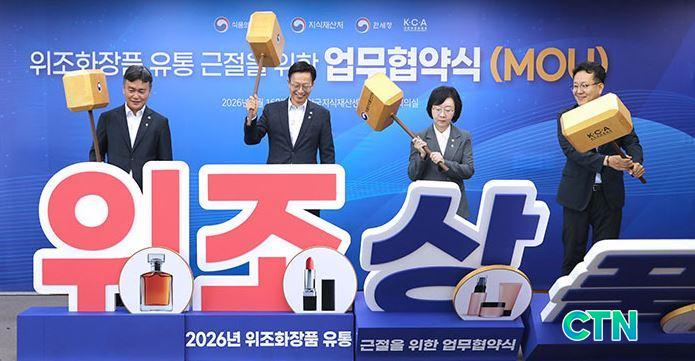
사진=지식재산처 제공
[지재처/CTN]가요진 기자= 오유경 식품의약품안전처장과 이종욱 관세청장, 김용선 지식재산처장은 "위조 화장품은 국민 건강과 K-뷰티의 신뢰를 위협하는 심각한 과제이자 기업들의 해외 진출 경쟁력에 직결되는 문제"라며 "이번 협약을 계기로 부처 간 위험 정보를 긴밀히 공유해 국경 통관 단계에서 위조 상품을 선제적으로 차단하는 한편, 주요 수출국 관세 당국 및 수사기관과의 국제 협력을 확대해 우리 기업들의 수출 장벽 해소와 지식재산권 보호에 최선을 다하겠다"고 밝혔다. 정부 산업 및 방역 사정 당국이 글로벌 시장에서 급성장하는 K-뷰티의 브랜드 신뢰도를 보호하고 해외 유입 위조 상품으로부터 국민의 안전을 확보하기 위해 범부처와 민간 업계를 아우르는 통합 지재권 보호 거버넌스를 전격 가동했다.
지식재산처는 식품의약품안전처, 관세청, 대한화장품협회와 함께 위조 화장품 대응을 위한 정부-업계 간 업무협약을 서울 강남구 한국지식재산센터 대회의실에서 지난 16일 체결했다고 발표했다. 이번 협약은 2025년 기준 수출액 114억 달러를 돌파하며 세계 2위 수출국으로 도약한 K-뷰티의 국제적 성장세에 편승해 위조 상품 유통 범죄가 급증함에 따라 마련됐다. 실제로 OECD 조사에 따르면 전 세계 한국 기업의 지재권 침해 위조 상품 규모는 97억 달러(약 11조 원)에 달하며, 이 중 화장품이 세관 압류가액 기준 10%를 차지해 전자제품과 섬유·의류에 이어 세 번째로 높은 비중을 기록하고 있다. 이에 따라 각 기관은 이번 협약식 이후 민관 협의체를 반기마다 정기적으로 운영하며 위조 화장품의 실시간 유통 정보 공유, 온라인 실태조사 협업, 화장품 영업자 대상 품질관리 체계 구축 및 안전성 검증 교육 등 실무적인 공동 대응 정책을 수립하기로 뜻을 모았다. 이날 행사는 각 기관별 추진 계획 발표와 서명식, 위조 화장품 근절 공연 순으로 진행됐으며 유튜브를 통해 실시간 생중계됐다고 청은 덧붙였다.
지방 및 중앙 행정 당국이 K-브랜드 보호라는 거시적 경제 국책 과제를 해결하기 위해 지재권 단속(지재처), 국경 통관(관세청), 위생 안전 규제(식약처) 등 파편화되어 있던 부처별 행정 라인을 하나의 민관 협의체로 묶어내고, 온라인 실태조사와 해외 관세 당국과의 사법 공조 체계를 정무적으로 제도화하려 한 시도는 수출 주도형 로컬 산업 보호 측면에서 실효성 높은 행정 사례로 풀이된다. 특히 단순한 적발 위주의 사후 처벌에서 벗어나 화장품 협회와 연계해 중소 영업자들의 국제 기준 대응 역량 강화 인센티브를 매칭하고, 범정부적 단속 역량을 정무적으로 일원화해 수출 기업의 무역 장벽을 선제적으로 해소하려 한 기획은 각 부처의 짜임새 있는 정무적 대외 협력 역량이 반영된 결과다.
그러나 일각에서는 이번 업무협약이 해외 직구나 온라인 오픈마켓을 통해 게릴라식으로 유통되는 위조 화장품의 실무적인 차단 기술이나 인력 확충안 없이, 유관기관들이 모여 MOU를 체결하고 생중계 공연을 벌이는 전형적인 보여주기식 전시 행정에 그치고 있다는 지적도 나온다. 연간 11조 원 규모로 비대해진 위조 상품 유통망을 상대로 '반기별 정기 회의' 수준의 느슨한 거버넌스를 구축한 것은 그럴듯한 명분에 비해 실무적인 현장 단속 기동성이 떨어지기 때문이다. 특히 중국이나 동남아 등 주요 제조·수출국 현지에서 은밀하게 생산되어 제3국으로 우회 유입되는 짝퉁 화장품을 실무적으로 단속할 사법권 보장이나 인공지능(AI) 기반의 온라인 모니터링 시스템 구축 같은 예산 매칭 로드맵이 빠져있다. 현장 단속 인력의 절대적 부족을 해결할 실무적인 재정 지원이나 위조품 유통 플랫폼에 대한 강력한 연대책임 부여 등 법적 규제 장치가 선행되지 않는다면, 단순한 정보 공유 위주의 협약은 결국 단속의 사각지대를 좁히지 못한 채 K-뷰티 신뢰 추락이라는 재앙을 막지 못할 위험이 크다. 이에 따라 지재처와 관계 부처들은 일회성 행사 홍보에 만족할 것이 아니라, 위조 화장품 상시 단스크 전담반을 즉각 가동하는 동시에 온라인 플랫폼 사들의 위조품 유통 방조 죄책을 엄중히 물을 수 있는 상표법 등 관련 자치 및 국가 법령 개정을 시급히 추진해야 할 것이다.
[영문번역 기사-AI활용]
Oh Yu-kyung, Minister of Food and Drug Safety, Lee Jong-wook, Commissioner of the Korea Customs Service, and Kim Yong-sun, Commissioner of the Intellectual Property Office, stated, "Counterfeit cosmetics are a serious challenge that threatens public health and the credibility of K-beauty, and are directly linked to the export competitiveness of our enterprises. Taking this agreement as an opportunity, we will closely share risk information among ministries to preemptively block counterfeit goods at the border clearance stage, while expanding international cooperation with customs authorities and investigative agencies in major exporting countries to resolve export barriers and protect intellectual property rights." The government industrial and quarantine audit authorities have completely activated an integrated intellectual property protection governance encompassing cross-government ministries and the private industry to protect the brand credibility of K-beauty, which is growing rapidly in the global market, and to secure public safety from overseas-sourced counterfeit goods.
The Intellectual Property Office announced on the 17th that it signed a government-industry memorandum of understanding (MOU) for responding to counterfeit cosmetics with the Ministry of Food and Drug Safety, the Korea Customs Service, and the Korea Cosmetic Association in the grand conference room of the Korea Intellectual Property Center in Gangnam-gu, Seoul on the 16th. This agreement was prepared as counterfeit distribution crimes soared by piggybacking on the international growth of K-beauty, which broke its all-time high with an export volume of 11.4 billion dollars as of 2025, ranking second in the world. In fact, according to an OECD survey, the scale of counterfeit goods infringing on the intellectual property rights of South Korean companies worldwide reaches 9.7 billion dollars (about 11 trillion won), with cosmetics accounting for 10% based on customs seizure value, ranking third following electronic products and textiles/apparel. Accordingly, after this signing ceremony, each agency agreed to regularly operate a public-private consultative body every half-year to establish practical joint response policies, such as sharing real-time distribution information of counterfeit cosmetics, collaborating on online inspection, and building quality control frameworks and safety verification education for cosmetics entrepreneurs. The office added that the event proceeded in the order of presenting implementation plans by institution, a signing ceremony, and a performance for eradicating counterfeit cosmetics, and was broadcast live through the YouTube channels of each institution.
The move where the local and central administrative authorities bound fragmented departmental administrative lines—such as intellectual property crackdown (Intellectual Property Office), border clearance (Customs Service), and sanitary safety regulation (Ministry of Food and Drug Safety)—into a single public-private consultative body to solve a macro-economic national task of protecting K-brands, and politically tried to institutionalize practical inspection and judicial cooperation frameworks with overseas customs authorities, is interpreted as a highly effective administrative case in terms of protecting export-led local industries. In particular, shifting away from a simple post-punishment crackdown, matching capacity-building incentives for small and medium-sized entrepreneurs to respond to international standards in connection with the Cosmetic Association, and politically unifying government-wide crackdown capabilities to preemptively resolve trade barriers for export enterprises highlights the reflection of each ministry's well-structured political external cooperation capabilities.
Hooking on the issue, however, some critics point out that this MOU merely stops at a government-led show-style exhibition administration that holds a live-broadcast performance after signing an agreement without practical blocking technologies or workforce reinforcement plans against counterfeit cosmetics distributed in a guerrilla manner through overseas direct purchases or online open markets. Building a loose governance at the level of a 'semi-annual regular meeting' against the counterfeit distribution network that has ballooned to an annual scale of 11 trillion won runs a lower practical on-site crackdown mobility compared to its plausible justification. In particular, a budget matching roadmap—such as securing judicial power to practically crack down on fake cosmetics secretly produced in major manufacturing and exporting countries like China or Southeast Asia and inflows via third countries, or building an artificial intelligence (AI)-based online monitoring system—is missing. If practical fiscal support to solve the absolute lack of field enforcement personnel or legal regulatory devices such as imposing joint liability on distribution platforms are not preceded, a simple information-sharing-oriented agreement runs a high risk of failing to block the disaster of K-beauty's credibility plunge while failing to narrow down the blind spots of crackdowns. Accordingly, the Intellectual Property Office and related ministries should not be satisfied with publicizing a one-off event, but should urgently promote related national and local regulation amendments, such as immediately activating a permanent counterfeit cosmetics crackdown task force and severely holding online platform companies accountable for aiding and abetting counterfeit distribution.
지식재산처는 식품의약품안전처, 관세청, 대한화장품협회와 함께 위조 화장품 대응을 위한 정부-업계 간 업무협약을 서울 강남구 한국지식재산센터 대회의실에서 지난 16일 체결했다고 발표했다. 이번 협약은 2025년 기준 수출액 114억 달러를 돌파하며 세계 2위 수출국으로 도약한 K-뷰티의 국제적 성장세에 편승해 위조 상품 유통 범죄가 급증함에 따라 마련됐다. 실제로 OECD 조사에 따르면 전 세계 한국 기업의 지재권 침해 위조 상품 규모는 97억 달러(약 11조 원)에 달하며, 이 중 화장품이 세관 압류가액 기준 10%를 차지해 전자제품과 섬유·의류에 이어 세 번째로 높은 비중을 기록하고 있다. 이에 따라 각 기관은 이번 협약식 이후 민관 협의체를 반기마다 정기적으로 운영하며 위조 화장품의 실시간 유통 정보 공유, 온라인 실태조사 협업, 화장품 영업자 대상 품질관리 체계 구축 및 안전성 검증 교육 등 실무적인 공동 대응 정책을 수립하기로 뜻을 모았다. 이날 행사는 각 기관별 추진 계획 발표와 서명식, 위조 화장품 근절 공연 순으로 진행됐으며 유튜브를 통해 실시간 생중계됐다고 청은 덧붙였다.
지방 및 중앙 행정 당국이 K-브랜드 보호라는 거시적 경제 국책 과제를 해결하기 위해 지재권 단속(지재처), 국경 통관(관세청), 위생 안전 규제(식약처) 등 파편화되어 있던 부처별 행정 라인을 하나의 민관 협의체로 묶어내고, 온라인 실태조사와 해외 관세 당국과의 사법 공조 체계를 정무적으로 제도화하려 한 시도는 수출 주도형 로컬 산업 보호 측면에서 실효성 높은 행정 사례로 풀이된다. 특히 단순한 적발 위주의 사후 처벌에서 벗어나 화장품 협회와 연계해 중소 영업자들의 국제 기준 대응 역량 강화 인센티브를 매칭하고, 범정부적 단속 역량을 정무적으로 일원화해 수출 기업의 무역 장벽을 선제적으로 해소하려 한 기획은 각 부처의 짜임새 있는 정무적 대외 협력 역량이 반영된 결과다.
그러나 일각에서는 이번 업무협약이 해외 직구나 온라인 오픈마켓을 통해 게릴라식으로 유통되는 위조 화장품의 실무적인 차단 기술이나 인력 확충안 없이, 유관기관들이 모여 MOU를 체결하고 생중계 공연을 벌이는 전형적인 보여주기식 전시 행정에 그치고 있다는 지적도 나온다. 연간 11조 원 규모로 비대해진 위조 상품 유통망을 상대로 '반기별 정기 회의' 수준의 느슨한 거버넌스를 구축한 것은 그럴듯한 명분에 비해 실무적인 현장 단속 기동성이 떨어지기 때문이다. 특히 중국이나 동남아 등 주요 제조·수출국 현지에서 은밀하게 생산되어 제3국으로 우회 유입되는 짝퉁 화장품을 실무적으로 단속할 사법권 보장이나 인공지능(AI) 기반의 온라인 모니터링 시스템 구축 같은 예산 매칭 로드맵이 빠져있다. 현장 단속 인력의 절대적 부족을 해결할 실무적인 재정 지원이나 위조품 유통 플랫폼에 대한 강력한 연대책임 부여 등 법적 규제 장치가 선행되지 않는다면, 단순한 정보 공유 위주의 협약은 결국 단속의 사각지대를 좁히지 못한 채 K-뷰티 신뢰 추락이라는 재앙을 막지 못할 위험이 크다. 이에 따라 지재처와 관계 부처들은 일회성 행사 홍보에 만족할 것이 아니라, 위조 화장품 상시 단스크 전담반을 즉각 가동하는 동시에 온라인 플랫폼 사들의 위조품 유통 방조 죄책을 엄중히 물을 수 있는 상표법 등 관련 자치 및 국가 법령 개정을 시급히 추진해야 할 것이다.
[영문번역 기사-AI활용]
Oh Yu-kyung, Minister of Food and Drug Safety, Lee Jong-wook, Commissioner of the Korea Customs Service, and Kim Yong-sun, Commissioner of the Intellectual Property Office, stated, "Counterfeit cosmetics are a serious challenge that threatens public health and the credibility of K-beauty, and are directly linked to the export competitiveness of our enterprises. Taking this agreement as an opportunity, we will closely share risk information among ministries to preemptively block counterfeit goods at the border clearance stage, while expanding international cooperation with customs authorities and investigative agencies in major exporting countries to resolve export barriers and protect intellectual property rights." The government industrial and quarantine audit authorities have completely activated an integrated intellectual property protection governance encompassing cross-government ministries and the private industry to protect the brand credibility of K-beauty, which is growing rapidly in the global market, and to secure public safety from overseas-sourced counterfeit goods.
The Intellectual Property Office announced on the 17th that it signed a government-industry memorandum of understanding (MOU) for responding to counterfeit cosmetics with the Ministry of Food and Drug Safety, the Korea Customs Service, and the Korea Cosmetic Association in the grand conference room of the Korea Intellectual Property Center in Gangnam-gu, Seoul on the 16th. This agreement was prepared as counterfeit distribution crimes soared by piggybacking on the international growth of K-beauty, which broke its all-time high with an export volume of 11.4 billion dollars as of 2025, ranking second in the world. In fact, according to an OECD survey, the scale of counterfeit goods infringing on the intellectual property rights of South Korean companies worldwide reaches 9.7 billion dollars (about 11 trillion won), with cosmetics accounting for 10% based on customs seizure value, ranking third following electronic products and textiles/apparel. Accordingly, after this signing ceremony, each agency agreed to regularly operate a public-private consultative body every half-year to establish practical joint response policies, such as sharing real-time distribution information of counterfeit cosmetics, collaborating on online inspection, and building quality control frameworks and safety verification education for cosmetics entrepreneurs. The office added that the event proceeded in the order of presenting implementation plans by institution, a signing ceremony, and a performance for eradicating counterfeit cosmetics, and was broadcast live through the YouTube channels of each institution.
The move where the local and central administrative authorities bound fragmented departmental administrative lines—such as intellectual property crackdown (Intellectual Property Office), border clearance (Customs Service), and sanitary safety regulation (Ministry of Food and Drug Safety)—into a single public-private consultative body to solve a macro-economic national task of protecting K-brands, and politically tried to institutionalize practical inspection and judicial cooperation frameworks with overseas customs authorities, is interpreted as a highly effective administrative case in terms of protecting export-led local industries. In particular, shifting away from a simple post-punishment crackdown, matching capacity-building incentives for small and medium-sized entrepreneurs to respond to international standards in connection with the Cosmetic Association, and politically unifying government-wide crackdown capabilities to preemptively resolve trade barriers for export enterprises highlights the reflection of each ministry's well-structured political external cooperation capabilities.
Hooking on the issue, however, some critics point out that this MOU merely stops at a government-led show-style exhibition administration that holds a live-broadcast performance after signing an agreement without practical blocking technologies or workforce reinforcement plans against counterfeit cosmetics distributed in a guerrilla manner through overseas direct purchases or online open markets. Building a loose governance at the level of a 'semi-annual regular meeting' against the counterfeit distribution network that has ballooned to an annual scale of 11 trillion won runs a lower practical on-site crackdown mobility compared to its plausible justification. In particular, a budget matching roadmap—such as securing judicial power to practically crack down on fake cosmetics secretly produced in major manufacturing and exporting countries like China or Southeast Asia and inflows via third countries, or building an artificial intelligence (AI)-based online monitoring system—is missing. If practical fiscal support to solve the absolute lack of field enforcement personnel or legal regulatory devices such as imposing joint liability on distribution platforms are not preceded, a simple information-sharing-oriented agreement runs a high risk of failing to block the disaster of K-beauty's credibility plunge while failing to narrow down the blind spots of crackdowns. Accordingly, the Intellectual Property Office and related ministries should not be satisfied with publicizing a one-off event, but should urgently promote related national and local regulation amendments, such as immediately activating a permanent counterfeit cosmetics crackdown task force and severely holding online platform companies accountable for aiding and abetting counterfeit distribution.
 |
가요진 기자 gyj1119@naver.com
|
#지식재산처 #김용선처장 #식품의약품안전처 #오유경처장 #관세청 #이종욱처장 #대한화장품협회 #서경배회장 #위조화장품근절 #K뷰티보호 #지재권침해 #민관협의체 #정치뉴스 #지방행정 #CTN